
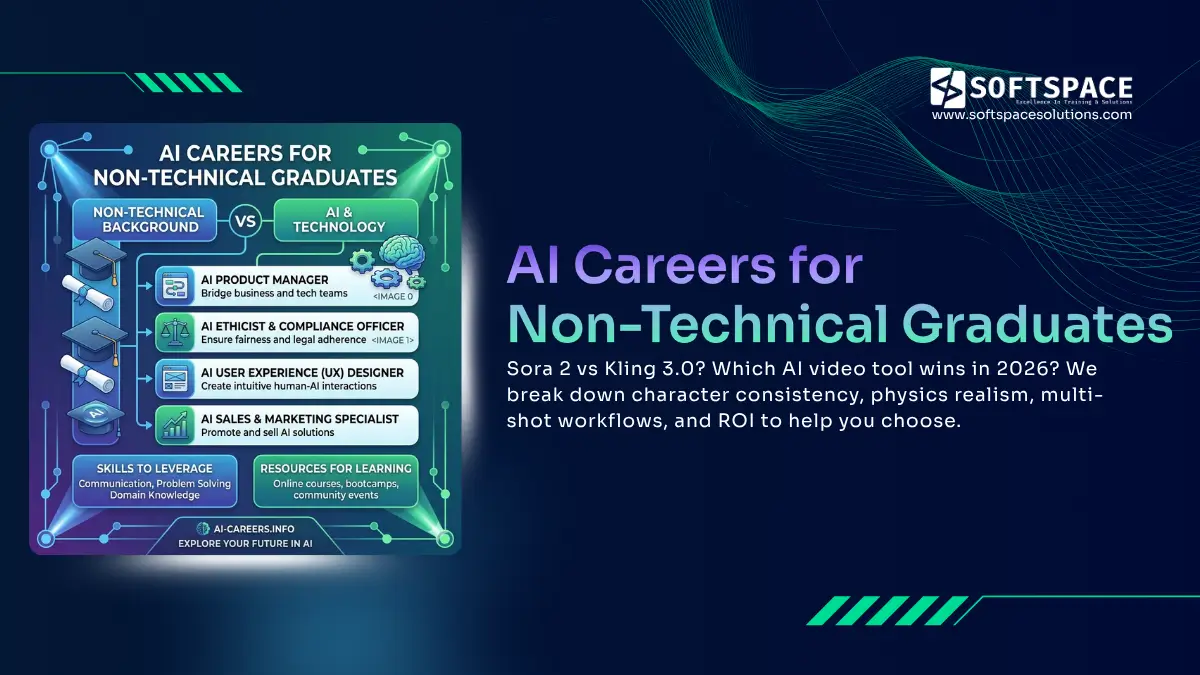
If you graduated with a degree in Psychology, Law, Commerce, Mass Communication, or the Humanities, you have probably watched the AI boom from the sidelines and assumed it was not meant for you.
It is. And the opportunity is bigger than most people realise.
AI careers for non-technical graduates are not a niche exception. They are quickly becoming one of the fastest-growing job categories in India’s tech sector. Companies building AI systems do not just need engineers. They need people who understand human behaviour, can write with precision, spot ethical blind spots, and translate business goals into AI-ready tasks.
According to PwC, AI is expected to contribute over $15 trillion to the global economy by 2030. India alone is projected to capture a significant share of that through its booming AI services and product ecosystem. And the demand for non-technical AI talent is growing faster than supply.
So if you have been waiting for a sign to explore this space, this is it.
This guide covers the top non-coding AI jobs available in India right now, the skills employers are actually hiring for, what the salary landscape looks like, and a practical 90-day plan to get started, regardless of your educational background.
Table of Contents
Can You Really Work in AI Without a CS Degree?
Yes, and this is not just motivational talk.
AI systems require far more than code to function well. They need clear instructions, cultural context, ethical guardrails, user research, product strategy, and legal compliance. None of those come from a computer science curriculum.
Google, Microsoft, Meta, and hundreds of Indian startups have been quietly hiring professionals with backgrounds in design, law, linguistics, and social sciences for AI-specific roles. Job titles like AI Trainer, Prompt Engineer, AI Ethicist, and Trust and Safety Specialist did not exist five years ago. Today, they appear on job boards across Naukri, LinkedIn, and Wellfound every single week.
The India-specific angle matters here too. Most of these roles require a deep understanding of regional languages, cultural nuance, and the lived reality of Indian users. That is something no algorithm can replace, and something a non-technical graduate from India is uniquely positioned to provide.
If you have ever wondered whether it is too late to switch to an AI career, the answer is almost certainly no. India’s AI job market is still in an early expansion phase, and the window for non-technical professionals to enter is wide open.
Top Non-Coding AI Jobs in India for 2026
Here are the roles that are actively hiring non-technical graduates in India right now.
1. AI Product Manager
An AI Product Manager acts as the bridge between engineering teams and end users. You do not write code. You define what gets built, why it should be built, and how it solves a real problem.
This role is ideal for graduates with a background in Business Administration, Economics, or any domain where you have learned to gather requirements, prioritise problems, and communicate across teams.
In India, AI PMs are in demand at companies like Freshworks, Meesho, Razorpay, and dozens of funded AI startups. If you already have experience in product, operations, or business analysis, transitioning into an AI PM role is one of the most natural moves available to you.
Starting salaries in India typically range from Rs 12 LPA to Rs 25 LPA, depending on experience and company size.
2. Prompt Engineer and AI Content Designer
Prompt engineering is the practice of writing precise instructions that guide AI models to produce accurate, consistent, and useful outputs. It sounds simple, and that is exactly why most people underestimate how skilled it actually requires you to be.
Good prompt engineers combine the thinking of an editor, a logician, and a teacher. They understand language deeply, anticipate how a model will misinterpret an instruction, and iterate until the output meets a quality bar.
This role is particularly well-suited to graduates with a background in English, Journalism, Mass Communication, or any field that trained you to write with clarity and intention.
If you want to explore this path further, check out this detailed breakdown of how to become a prompt engineer.
Freelance prompt engineers in India can earn anywhere from Rs 30,000 to Rs 1,50,000 per month, depending on the platform and specialisation. Full-time roles are also emerging at AI labs and product companies.
3. AI Ethicist and Responsible AI Advisor
AI Ethicists are the conscience of artificial intelligence. They review AI systems for bias, evaluate the societal impact of automation decisions, and ensure that AI deployments align with human values and legal requirements.
This role is tailor-made for graduates in Philosophy, Sociology, Law, or Public Policy. If you have ever written research papers on social inequality, analysed power structures, or studied constitutional rights, you already have the foundational thinking that this role demands.
In India, this function is growing rapidly within the IT arms of banks, healthcare companies, and large-scale government AI initiatives. NASSCOM and several IIT-affiliated AI governance labs are also expanding in this area.
4. AI Trainer and Human-in-the-Loop Specialist
AI models do not learn on their own. They need human feedback to improve. AI Trainers review model outputs, label data, flag errors, and provide structured feedback that helps the model understand what good looks like.
This is one of the most accessible entry points into the AI industry for fresh graduates. You do not need technical skills. You need attention to detail, strong language ability, cultural fluency, and the patience to be consistent.
Platforms like Scale AI, Outlier, and Appen regularly hire Indian professionals for these roles. Starting pay varies from Rs 20,000 per month for part-time freelance work to Rs 8 LPA and above for full-time positions at established AI companies.
Over time, Human-in-the-Loop specialists often move into QA lead roles, data annotation management, or AI evaluation strategy.
5. UX Researcher for Human-AI Interaction
UX Researchers who specialise in Human-AI Interaction study how people actually use AI tools. They run usability studies, conduct interviews, identify where trust breaks down, and feed insights back to the product and engineering teams.
If you have a background in Psychology, Cognitive Science, Design, or Anthropology, this role is one of the best AI career paths available to you. The ability to understand human behaviour and translate it into design recommendations is a skill that no AI model can replicate.
Companies like Swiggy, CRED, PhonePe, and dozens of SaaS startups are actively building Human-AI experience research teams in India. Salaries for mid-level UX Researchers with an AI focus range from Rs 10 LPA to Rs 20 LPA.
6. Trust, Safety, and Compliance Specialist
If you are a Law or Political Science graduate, this is arguably the highest-value AI career path open to you.
Trust and Safety teams manage the risks that come with deploying AI at scale. They handle content moderation policy, regulatory compliance (including India’s IT Rules and the emerging AI governance frameworks), and cross-border legal risk.
As India moves toward establishing a domestic AI regulatory framework, the demand for professionals who understand both AI systems and Indian law is going to increase sharply over the next three years.
Large tech companies, fintech firms, and social media platforms are all building these teams. Starting salaries range from Rs 10 LPA to Rs 18 LPA for entry to mid-level roles.
7 Skills Employers Actually Want From Non-Technical AI Candidates
The skills that make you valuable in an AI team are not the ones most people focus on. Here is what actually gets you hired.
1. Specification Precision
This is the ability to write instructions, prompts, or requirements so clearly that they produce consistent results across thousands of inputs. It is not about vocabulary. It is about anticipating ambiguity and eliminating it before it becomes a problem.
This skill is developed through practice, writing prompts, refining them, testing them, and documenting what works.
2. AI Evaluation (Evals)
Evals is the process of systematically testing AI output quality. Can you design a rubric to assess whether a model’s response is accurate, helpful, and appropriate? Can you identify failure modes before they reach users?
This is a high-value skill that very few candidates, technical or otherwise, have invested in developing. If you can build and document evaluation frameworks for AI outputs, you will stand out significantly.
3. Task Decomposition
Task decomposition means breaking a complex business goal into smaller, AI-executable steps. For example, if the goal is to summarise customer complaints by category, you need to map out each step: data input, preprocessing, classification prompt, output formatting, and review mechanism.
This is fundamentally a thinking skill, not a coding skill. Business graduates, project managers, and operations professionals are often very good at this.
4. Output Verification and Critical Thinking
AI models hallucinate. They produce confident, fluent, and completely wrong answers. The ability to catch this requires calibrated scepticism, domain knowledge, and strong reasoning.
If your degree trained you to evaluate sources, construct arguments, or spot logical fallacies, that skill transfers directly to AI output verification. For more on building this kind of analytical edge, see this guide on the importance of skill development in India.
5. Workflow Orchestration
Workflow orchestration means connecting AI tools into functional, automated systems. You do not need to write code to do this. Platforms like Zapier, Make, and MindStudio allow non-technical users to build multi-step AI workflows with no programming required.
If you can map a business process and connect the right tools to automate it, you are doing workflow orchestration.
6. Model Selection and Comparison
Understanding the trade-offs between different AI models, such as when to use GPT-4o vs Claude vs Gemini, and what each is better suited for, is a practical skill that demonstrates genuine AI literacy.
You do not need to understand the mathematics. You need to understand the use cases, costs, latency differences, and quality benchmarks at a functional level.
7. Cross-Functional Communication
AI does not operate in a silo. It needs to be integrated into sales funnels, legal workflows, customer support systems, and HR processes. The professional who can translate between the engineering team and the legal, marketing, or operations department is genuinely rare and genuinely valuable.
This is a soft skill that most CS graduates have not been trained to develop. Non-technical graduates often have a natural advantage here.
These are the kinds of capabilities that go beyond a traditional resume. If you want to know how to present them well, this guide on good skills to put on a resume is worth reading.
Non-Coding AI Jobs in India: What the Market Actually Looks Like
India’s AI job market is expanding rapidly, and the non-technical segment is growing faster than most people realise.
Bengaluru, Hyderabad, Pune, and Mumbai remain the primary hubs for AI employment. But remote-first roles are becoming increasingly common, which means professionals in Tier 2 cities like Nagpur, Jaipur, Ahmedabad, and Kochi now have genuine access to these opportunities.
India’s leading educational institutions have taken notice. IIT Delhi, IIM Kozhikode, and ISB Online now offer AI strategy and management programmes specifically designed for non-engineers. These programmes focus on business applications of AI, ethics, governance, and product thinking rather than machine learning theory.
The “AI Transformation Lead” and “AI Business Analyst” roles are particularly prominent in India’s IT services sector. Companies like TCS, Infosys, Wipro, and HCL are actively upskilling and hiring for these positions to serve their global client base.
One emerging trend is the industry’s “player-coach” role. This is a professional who understands both business strategy and AI capabilities well enough to lead projects without being the person who builds the system. It is a multidisciplinary function, and it is one of the most sought-after profiles in Indian tech right now.
If you are looking at the broader landscape of which careers are growing in India, this overview of the fastest growing careers in India provides useful context.
The 90-Day Roadmap to Break Into AI as a Non-Technical Graduate
You do not need a year-long bootcamp. You need a focused 90 days.
Month 1: Build Your AI Literacy
Start with the fundamentals. You need to understand how AI works at a conceptual level without getting lost in the mathematics.
Recommended starting points:
- “AI for Everyone” by Andrew Ng on Coursera (free to audit)
- Google’s Generative AI Learning Path on Google Cloud Skills Boost
- Microsoft’s AI Skills Challenge on Microsoft Learn
Focus on understanding concepts like supervised learning, training data, bias, model evaluation, and the difference between narrow AI and general AI. You do not need to build anything yet. You need to be able to hold a fluent conversation about these ideas in an interview.
Spend time using AI tools daily. ChatGPT, Claude, Gemini, Perplexity. Use them for real tasks. Observe where they succeed and where they fail. Take notes.
For a curated list of learning resources, this roundup of the best YouTube channels to learn AI is a solid starting point.
Month 2: Build a Portfolio
This is where most non-technical candidates stop themselves. They assume they have nothing to show because they have not built an app or trained a model.
That thinking is wrong.
Your portfolio as a non-technical AI professional can include:
- A documented prompt engineering project (write 20 prompts for a specific use case, test them, iterate, and document what you learned)
- An AI workflow you built using no-code tools to automate a real task
- A short evaluation rubric you designed to assess AI output quality
- A case study of an AI tool you tested critically, identifying its strengths, failure modes, and ethical considerations
You can build all of this without writing a single line of code. Platforms like MindStudio, Voiceflow, and Make allow you to create functional AI-powered workflows as a non-developer.
The goal is to demonstrate that you can work with AI, think critically about it, and document your process clearly. For inspiration on building things without code, this guide on how to build your first AI app without coding is worth reading.
Month 3: Network and Reframe Your Narrative
By month three, your focus shifts to positioning.
The most important move is translating your non-technical background into AI-relevant language. This does not mean lying. It means framing accurately.
Some examples:
- “Thematic analysis of qualitative data” (Psychology) becomes “extracting structured insights from unstructured human responses”
- “Legal contract review” (Law) becomes “identifying compliance risks and policy violations in AI output”
- “Consumer behaviour research” (Marketing/MBA) becomes “mapping user mental models to evaluate AI product-market fit”
- “Journalism” becomes “fact-checking AI outputs for accuracy and source reliability”
Update your LinkedIn profile with these reframes. Write a post about what you have learned in the past 60 days. Join communities like AI Professionals India on LinkedIn, AI Safety India, and relevant Discord servers.
Target companies that are actively building AI products or implementing AI internally. Use the hidden job market, referrals, and direct outreach rather than relying solely on applications. This guide on navigating the hidden job market explains how to approach this effectively.
Salary Expectations for Non-Technical AI Roles in India (2026)
Here is a realistic salary picture for non-technical AI roles in India based on current market data.
- Entry-level AI Trainer or Data Annotator: Rs 3.5 LPA to Rs 6 LPA
- Prompt Engineer (mid-level): Rs 8 LPA to Rs 15 LPA
- AI Product Manager (mid to senior): Rs 15 LPA to Rs 30 LPA
- AI Ethicist or Responsible AI Advisor: Rs 10 LPA to Rs 22 LPA
- UX Researcher with AI Focus: Rs 8 LPA to Rs 18 LPA
- Trust and Safety Specialist: Rs 8 LPA to Rs 20 LPA
- AI Business Analyst: Rs 6 LPA to Rs 14 LPA
For global roles or MNC positions in India, starting salaries are often higher, particularly for AI PMs and Responsible AI roles, where international benchmarks of $85,000 to $120,000 per year are becoming more common.
Contract and freelance options are also available for roles such as AI Trainer and Prompt Engineer. Platforms like Outlier and Appen offer project-based work that can serve as both income and portfolio building while you are transitioning.
For a broader view of where AI roles sit in the overall salary landscape, this breakdown of the highest-paying AI jobs provides useful context.
Common Myths About AI Careers for Non-Technical Graduates
Let us address the hesitations that hold people back.
MYTH 1: “I need to learn Python first.”
You do not, for most of the roles covered in this article. Prompt engineering, AI ethics, UX research, trust and safety, and AI product management do not require Python. Learning it can help over time, but it is not the entry requirement.
MYTH 2: “AI will replace these roles anyway.”
Counterintuitively, the more AI expands, the more demand grows for humans who can oversee it, evaluate it, and guide it. Human-in-the-loop is not a temporary phase. It is a structural feature of how AI systems work. AI cannot ethically supervise itself.
MYTH 3: “Only IIT or IIM graduates can get these jobs.”
The AI industry is one of the few tech sectors where demonstrable skill consistently outranks pedigree. A well-documented portfolio and a clear ability to work with AI tools carry more weight with most AI startups than the name of your college.
MYTH 4: “I am too late.”
India’s AI sector is still in early growth. Most of the large-scale AI deployments that will require non-technical AI specialists have not happened yet. The professionals who start building experience and portfolios now will be ahead of the curve in 2027 and 2028.
Conclusion
The AI industry does not need everyone to be an engineer. It needs people who can make AI work for real humans, in real contexts, with the right values and judgment in place.
That means it needs people like you.
Whether your background is in Law, Psychology, Business, Design, or Humanities, there is a meaningful role for you in the AI ecosystem. The path is not about learning to code. It is about learning to think with AI, work alongside it, and contribute the human insight that no model can generate on its own.
Start with 30 minutes a day. Take one free course. Build one small project. Reframe one skill on your resume.
The job market for AI careers for non-technical graduates in India is real, growing, and hiring now. The only question is whether you start today or spend another year watching from the sidelines.
If you are serious about making the move, this AI career survival guide for India in 2026 is worth bookmarking as your ongoing reference.
Frequently Asked Questions
Can I get an AI job in India without a CS degree?
Yes. Many high-demand AI roles, including AI Trainer, Prompt Engineer, AI Ethicist, UX Researcher, and Trust and Safety Specialist, do not require a computer science degree. What matters is your ability to work with AI tools, think critically, and bring domain expertise from your own background.
What are the best non-coding AI jobs in India in 2026?
The top non-coding AI jobs in India include AI Product Manager, Prompt Engineer, AI Ethicist, AI Trainer or Human-in-the-Loop Specialist, UX Researcher for Human-AI Interaction, Trust and Safety Specialist, and AI Business Analyst. These roles are available at Indian tech companies, AI startups, and multinational corporations.
How long does it take to transition into an AI career from a non-technical background?
Most people can make a credible transition within 90 days of focused effort. The key steps are building AI literacy through free courses, creating a portfolio of AI projects using no-code tools, and reframing your existing skills in AI-relevant language for your resume and LinkedIn profile.
Which Indian cities have the most non-coding AI jobs?
Bengaluru, Hyderabad, Pune, and Mumbai have the highest concentration of non-coding AI roles. However, the growth of remote-first AI jobs means professionals in Tier 2 cities like Nagpur, Jaipur, Ahmedabad, and Kochi can now access many of these opportunities without relocating.
What salary can a non-technical graduate expect in an AI role in India?
Salaries vary by role and experience. Entry-level AI Trainer roles start around Rs 3.5 LPA to Rs 6 LPA. Mid-level Prompt Engineers and AI Business Analysts earn Rs 8 LPA to Rs 15 LPA. AI Product Managers and AI Ethicists at mid to senior levels can command Rs 15 LPA to Rs 30 LPA or more.

Content Strategist | AI Tools Practitioner | Career & Study Abroad Consultant
Sagar Hedau is a content strategist and AI tools practitioner based in Nagpur, India. With 13+ years of experience in career counselling and psychometry, he now works at the intersection of content strategy and no-code AI technology, using tools like Claude, Lovable, LovArt, and Notion AI in his daily workflow. He writes to make AI genuinely accessible for non-technical professionals, students, and business owners who want to build and automate without coding. He also runs an active career counselling practice, helping individuals navigate career decisions with data-backed psychometric analysis.
🌐 sagarhedau.com | 💼 LinkedIn