
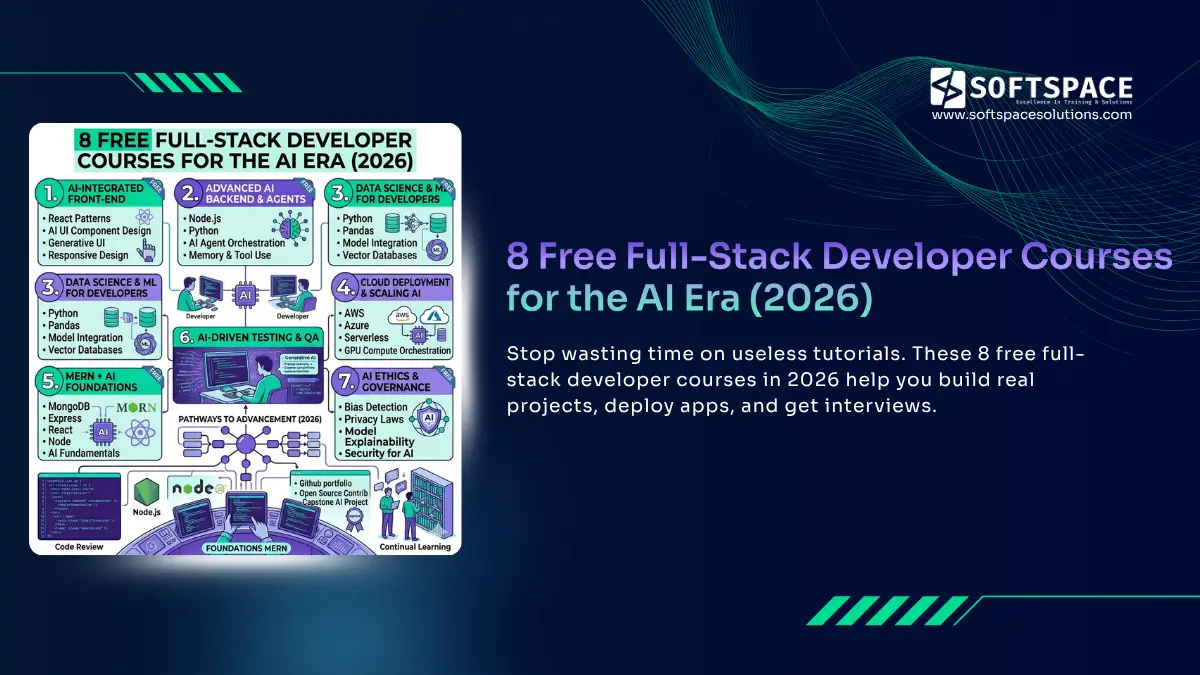
The best free full-stack developer courses in 2026 are not the same courses that ranked in 2024 or even early 2025. The field has shifted. Courses that taught HTML, CSS, React, and Node.js in isolation are now missing an entire layer of what employers actually want: the ability to build with AI tools, integrate language model APIs, and work inside AI-native development environments like Cursor or Windsurf.
This guide is a companion to the Full Stack Developer Career Path 2026 pillar post. Where that article maps the complete roadmap from fundamentals to AI-agent architecture, this post has one focused purpose: to help you find the right free course for where you are right now, and be honest about what each one will and will not get you.
The eight courses here are split into two tiers. Tier one covers updated foundational courses for those building the traditional MERN and Java full-stack baseline. Tier two covers AI-era courses for developers ready to add agent workflows, vector search, and low-code-to-pro-code thinking to their stack. Each course comes with an honest take, an AI-readiness tag, and a persona match so you can decide in under a minute whether it is the right fit.
“A 2-hour free course will not get you hired. But the right free course, paired with a real project and consistent practice, absolutely can open the first door.”
Table of Contents
All 8 Courses at a Glance
| # | Course Name | Tier | AI Readiness | Duration |
| 1 | Become a Full-Stack Developer | Foundation | Foundation Only | 1.5 hrs |
| 2 | Crash Course in Full Stack Development | Foundation | Foundation Only | 18 hrs |
| 3 | Getting Started with Full-Stack Development (Java) | Foundation | AI-Adjacent | 50+ hrs |
| 4 | Full Stack Web Developer Course (Python + Django) | Foundation | AI-Adjacent | 40 hrs |
| 5 | AI-Augmented MERN + MongoDB Atlas Vector Search | AI Era | AI-Native | 10-15 hrs |
| 6 | Python Agentic Workflows with LangChain (DeepLearning.AI) | AI Era | AI-Native | 1-3 hrs/module |
| 7 | No-Code to Low-Code with Lovable and Bolt | AI Era | AI-Native | Self-paced |
| 8 | Spring AI for Java: Enterprise AI Integration | AI Era | AI-Native | 8-12 hrs |
Why Most 2025 Free Full-Stack Courses Are Already Outdated?
The previous version of this post listed courses from Great Learning, Simplilearn, Springboard, and Udemy. Those courses are still valid introductions to web development concepts. But they were built for a job market that no longer exists in the same form.
Here is what changed. In 2025 and into 2026, the average developer job description at a product company started including phrases like “experience with LLM APIs,” “familiarity with AI agent frameworks,” and “ability to work with vector databases.” A course that ends at Express routes and MongoDB CRUD is leaving a significant gap between what you know and what employers are looking for.
That does not mean you should skip the fundamentals. It means the fundamentals now have an extra layer. Understanding React is still necessary. Understanding how to integrate a React frontend with a retrieval-augmented generation backend is what moves a resume from the discard pile to the interview shortlist.
The skill gap in India is partly driven by this lag between what educational platforms are teaching and what the industry is actively hiring for. This guide tries to close that gap with the best free options currently available.
How to Choose the Right Free Full-Stack Course for 2026
Before diving into the list, spend two minutes with these four filters. They will save you hours of starting the wrong course.
Filter 1: What Is Your Goal
- Getting your first developer job: You need Tier 1 foundations plus at least one project deployed live. Choose a course with project-based learning.
- Upskilling from a non-technical background: Start with the No-Code to Low-Code track in Tier 2. Build something first, then learn how it works.
- Transitioning from another tech role: If you already know one language or framework, move to the AI-era courses directly.
- Freelancing or building a product: Prioritise courses covering full deployment, not just local development.
Filter 2: How Much Time Do You Actually Have
Be honest. A 50-hour course is genuinely valuable. It is also something most people with a job or family cannot complete in one sprint. If your realistic window is two hours a week, a shorter, focused course you actually finish is worth more than a comprehensive course you abandon at module three.
Filter 3: Your Current Skill Level
- Zero coding experience: Courses 1, 2, or 7 (the No-Code track)
- Basic HTML/CSS/JS knowledge: Courses 3 or 4
- Working knowledge of one framework: Courses 5, 6, or 8
Filter 4: AI-Readiness of the Course
Each course in this list carries one of three tags:
- AI-Native: The course is built specifically for 2026 tooling and includes AI integration as a core subject.
- AI-Adjacent: The course covers a stack that is ready to receive AI features but does not teach them directly.
- Foundation Only: Strong fundamentals course with no AI content. Valuable as a starting point, not as a standalone path.
“The course is just the container. What you build after the course is the actual qualification.”
With those filters in mind, here is the updated list.
Tier 1: Foundation Courses — The Updated MERN and Java Baseline
These courses cover the traditional full-stack skill set. They have been selected because they remain relevant as a starting point in 2026, either because their content is genuinely solid or because the platform has updated them to reflect current tooling.
1. Become a Full-Stack Developer
Provider: Great Learning Academy AI Readiness: [Foundation Only] Best For: Complete beginners who want a clear picture of the field before committing to a longer course
Duration: 1.5 hours
What you will learn:
- Full stack developer roles and what the job actually involves day to day
- Overview of front-end and back-end architecture without getting into code
- Career path options from junior developer to technical lead
- How front-end and back-end communicate through APIs
Honest Take: This is a scene-setter, not a skill-builder. It will help you decide if full-stack development is the direction you want to go. It will not prepare you for a technical interview or a live project. Think of it as the pre-course before the actual course.
2. Crash Course in Full Stack Development
Provider: Great Learning Academy AI Readiness: [Foundation Only] Best For: Beginners who want hands-on exposure to HTML, CSS, JavaScript, and React without a long-term commitment
Duration: 18 hours
What you will learn:
- HTML and CSS for structuring and styling web pages
- JavaScript fundamentals including DOM manipulation
- Introduction to ReactJS and Angular for component-based development
- PHP for basic back-end logic
- jQuery for simplified JavaScript interactions
Honest Take: At 18 hours this is one of the more substantial free options at this level. The PHP inclusion feels dated for 2026 but the React and JavaScript sections are useful. Complete this, then immediately build a small personal project before moving to a more advanced course.
3. Getting Started with Full-Stack Development (Java)
Provider: Simplilearn SkillUp AI Readiness: [AI-Adjacent] Best For: Java developers or students who want enterprise-track full-stack skills with Spring Boot
Duration: 50+ hours
What you will learn:
- Java fundamentals through to object-oriented design patterns
- Spring Boot for building REST APIs and microservices
- React and TypeScript for the front-end layer
- MongoDB and MySQL for database management
- Git, CI/CD basics, and deployment pipelines
Honest Take: This is the most comprehensive free option on the list. At 50+ hours, it is a proper course, not a taster. The Java and Spring Boot coverage is particularly strong for anyone targeting enterprise companies. The AI-Adjacent tag reflects that Spring AI is not yet covered here, but the Spring Boot foundation makes it straightforward to add that layer independently.
If Java is your chosen path, the Java full stack developer guide is an essential companion to this course.
4. Full Stack Web Developer Course (Python and Django)
Provider: Springboard AI Readiness: [AI-Adjacent] Best For: Python learners who want a full-stack path and plan to extend into LangChain or agentic workflows afterwards
Duration: 40 hours
What you will learn:
- Python programming fundamentals and best practices
- Django for back-end development and database integration
- HTML, CSS, and JavaScript for the front-end
- SQL database management with PostgreSQL
- Deploying Django applications to production environments
Honest Take: Django remains one of the most practical back-end frameworks for developers who eventually want to work with AI pipelines. LangChain, CrewAI, and most Python-based agent frameworks integrate naturally with a Django backend. Completing this course and then adding a LangChain integration project on top gives you a genuinely hireable combination for 2026.
For those interested in the Python specialisation path, the Python developer career path maps out where this skill set leads over a full career arc.
Tier 2: AI-Era Courses — Building for 2026 and Beyond
These courses are specifically chosen because they address the AI-native layer of full-stack development. Some are newer courses built directly for the current tooling landscape. Others are established courses on platforms where the content has been meaningfully updated. Each one teaches skills that appear in 2026 job descriptions, not 2023 ones.
5. AI-Augmented MERN Stack with MongoDB Atlas Vector Search
Provider: MongoDB University (Free) AI Readiness: [AI-Native] Best For: MERN developers who want to add semantic search and AI-ready data architecture to their existing skill set
Duration: 10 to 15 hours
What you will learn:
- MongoDB Atlas fundamentals and cloud-based data management
- Atlas Vector Search for embedding-based semantic retrieval
- Integrating vector search with a Node.js and Express backend
- Building AI-ready data models that support LLM retrieval pipelines
- Aggregation pipelines and performance optimisation for production workloads
Honest Take: This is the most directly relevant free course for developers building RAG systems or AI-powered search features. MongoDB University courses are consistently high quality and regularly updated. The Vector Search module specifically addresses the pgvector versus Atlas Vector Search decision that developers face when architecting AI data layers. Strongly recommended for any MERN developer updating their skill set for 2026.
6. Python Agentic Workflows with LangChain
Provider: DeepLearning.AI (Free Short Courses) AI Readiness: [AI-Native] Best For: Developers with Python and basic API knowledge who want to build production-ready AI agents
Duration: 1 to 3 hours per module (multiple modules available)
What you will learn:
- LangChain fundamentals: chains, agents, memory, and tools
- Building retrieval-augmented generation pipelines from scratch
- CrewAI for multi-agent orchestration with role-based specialisation
- LangSmith for tracing and debugging agent behaviour in production
- Connecting agents to real data sources, including documents, databases, and APIs
Honest Take: DeepLearning.AI short courses are co-developed with the teams that build the frameworks themselves. The LangChain, CrewAI, and RAG courses here are taught by the people who wrote the code. For a free resource, the quality is exceptional. The format works best if you treat each module as a focused sprint rather than trying to complete the entire catalogue at once.
Understanding AI and machine learning fundamentals alongside these practical courses will give you the theoretical grounding to make better architectural decisions when building agent systems.
7. No-Code to Low-Code Full-Stack Development with Lovable and Bolt
Provider: Lovable Documentation and Community (Free) AI Readiness: [AI-Native] Best For: Non-technical professionals, career changers, and entrepreneurs who want to build and ship MVPs without a traditional coding background
Duration: Self-paced (documentation plus project-based)
What you will learn:
- Building complete full-stack applications using natural language prompts
- Understanding the React and Supabase architecture that Lovable generates
- Connecting to external APIs and databases without writing backend code manually
- Iterating on AI-generated code with prompts and basic manual edits
- Deploying a working product to a live URL
Honest Take: This is not a traditional course and that is precisely the point. Lovable and Bolt represent a genuine shift in how non-technical builders can create working software.
The documentation, community tutorials, and project examples function as a self-directed curriculum. The critical skill to develop here is not just building with these tools but understanding what they are generating well enough to debug them when something goes wrong. That understanding is what separates someone who can demo an MVP from someone who can actually maintain one.
The vibe coding guide explains the philosophy behind this kind of natural language development and what its real-world limitations look like in practice. It is required reading before you start building with these tools.
For a broader view of AI tools you can use to build without traditional coding, the how to build your first AI app without coding guide is a strong companion resource.
8. Spring AI for Java: Enterprise AI Integration
Provider: Spring Academy (Free Tier) AI Readiness: [AI-Native] Best For: Java developers at enterprise companies who need to add AI features to existing Spring Boot applications without rebuilding from scratch
Duration: 8 to 12 hours
What you will learn:
- Spring AI framework fundamentals and the ChatClient API
- Connecting Spring Boot applications to OpenAI, Anthropic, and Azure OpenAI
- Implementing RAG patterns with Spring AI and vector store integration
- Structured output from LLMs using Java type safety
- AI observability, token management, and production logging for Spring AI apps
Honest Take: Spring AI is the most practical path for Java developers at large organisations where a full-stack rewrite is not on the table. This course teaches you how to add AI capabilities to the infrastructure that is already in production. It is a genuinely underserved topic in free learning resources, which means completing it and building a Spring AI project puts you ahead of most Java full-stack developers in the current job market.
Essential Tools to Use Alongside Any of These Courses
A course teaches you concepts. Your tool environment is where those concepts become real skills. In 2026, learning full-stack development without these tools in your daily workflow is like learning to drive in a simulator and then being surprised by real traffic.
AI-Native IDEs
- Cursor: An AI-native code editor built on VS Code. The composer agent can understand your codebase and make changes across multiple files at once. Using Cursor while completing any of the above courses will dramatically accelerate your understanding of how code fits together.
- Windsurf: Similar positioning to Cursor with a strong agentic workflow for context-aware code generation. Both have free tiers.
Prototyping and Scaffolding Tools
- V0 by Vercel: Generates React component code from natural language descriptions. Excellent for rapidly building UI before writing business logic.
- Bolt by StackBlitz: Full-stack app generation in the browser. Particularly useful for seeing how a complete application is structured when you are still learning how the pieces connect.
Version Control and Deployment
- GitHub: Non-negotiable. Every project you build during these courses should be committed to a public GitHub repository. This is your portfolio.
- Vercel or Render: Free deployment for front-end and full-stack applications. A project that is live at a real URL is worth significantly more to a hiring manager than code that only runs locally.
The AI tools for coding guide covers additional tools worth integrating into your development workflow as you progress through these courses.
If you want to understand the specific tools used in AI-native web development, the AI tools for web development post covers what practitioners are actually using in 2026.
Full-Stack Developer Salary in India: The 2026 Update
The salary picture in 2026 has a story inside it that the numbers alone do not tell. The lower rows of this table represent roles that AI tools are actively compressing. The upper rows represent what happens when you add genuine AI integration skills to a traditional full-stack background.
| Company | Role / Stack | Avg. Salary (2026) |
| Optum | Full Stack (MERN/Java) | ₹11.6L – ₹20L |
| NielsenIQ | Full Stack Developer | ₹11.4L+ |
| Capgemini | Full Stack / Cloud | ₹6L – ₹9L |
| TCS | Full Stack Developer | ₹4.7L – ₹8L |
| Virtusa | Full Stack Developer | ₹5.6L – ₹8L |
| Product Startups | AI-Integrated Full Stack | ₹18L – ₹35L+ |
| Freelance / Remote | MERN + AI Agent Dev | ₹20L – ₹50L+ |
The most significant shift compared to 2025 is the premium for AI-integrated roles. Product startups and funded companies building AI-native products are paying 60 to 80% above market rate for full-stack developers who can integrate LLMs, build agent workflows, and understand vector database architecture.
Service company roles at TCS, Cognizant, and Capgemini remain relatively stable but are increasingly requiring AI tool proficiency even for mid-level positions. The developers earning at the higher end of those ranges in 2026 are the ones who can accelerate delivery using AI coding tools, not just the ones with the most years of experience.
For detailed salary analysis by role, the AI engineer salary trends 2026 and highest paying IT jobs in India provide full breakdowns across experience levels and company types.
EEAT: The Real State of Full-Stack Coding Jobs in 2026
This section exists because most free course lists do not talk about this. They recommend courses, list learning outcomes, and end with an encouraging conclusion. We think you deserve a clearer picture of what you are walking into.
What Is Happening to Coding Jobs Right Now
AI is not replacing full-stack developers wholesale. But it is restructuring the entry level in ways that are real and accelerating. Tasks that previously filled the first two years of a junior developer’s job, writing boilerplate, building CRUD interfaces, generating unit tests, and creating basic component layouts, are increasingly being handled by AI coding tools in minutes rather than days.
This has two effects. First, companies need fewer junior developers for the same output. Second, the junior developers they do hire need to demonstrate a higher baseline of competence than was expected before. Being able to set up a React app and connect it to an Express server is no longer a differentiator. It is a floor.
Several large Indian IT service firms reduced fresher intake in 2025, specifically citing AI productivity gains as a reason they could deliver the same project scope with a leaner team. This is not speculation. It is a documented pattern that is continuing into 2026.
The impact of AI on employment documents these patterns with data. And the jobs replaced by automation post provides a broader context on which categories of work are most exposed.
“The developers most at risk in 2026 are not the ones who use AI tools. They are the ones who are waiting to see if AI tools become important before learning them.”
How to Navigate This as a Learner in 2026
The answer is not to panic, and it is not to pretend the disruption is not happening. The practical path forward has three components.
- Build live things: A deployed application, even a simple one with a real AI feature, demonstrates more relevant capability than a completed course certificate. Employers in 2026 are scanning portfolios for evidence of AI integration, not just React and Node.js.
- Develop skills AI genuinely cannot replicate: System design, architecture decisions, debugging complex agent behaviour, translating business requirements into technical specifications, and communicating clearly with non-technical stakeholders. These skills are in demand precisely because AI cannot perform them reliably.
- Do not wait for a perfect learning path: Start with whatever tier-one course matches your current level. Build the first project. Then layer in the AI-era skills from tier two. The learners who are getting hired are the ones who started six months ago, not the ones who planned the perfect curriculum.
For those considering a broader career pivot or worried about whether it is too late to enter the field, the AI career survival guide for India 2026 addresses these questions directly with practical guidance.
If you are wondering whether the AI job market is oversaturated, the nuanced answer is this: it is competitive at the commodity skill level and genuinely short on supply at the AI-integration and systems design level. The level you enter at is a choice you are making right now through how you structure your learning.
What to Do After Completing a Course: The Project Plan
No course on this list, free or paid, will get you a job by itself. What gets you a job is a course, a project, a portfolio, plus preparation. Here is the minimal version of that path that actually works.
Step 1: Build One Focused Project Immediately
Do not wait until you feel ready. Start building while the course content is still fresh. The project does not need to be impressive. It needs to be finished and deployed. A simple AI-powered application, for example, a document Q&A tool, a job description analyser, or a personal portfolio with a chatbot, demonstrates more than a dozen tutorial repositories.
Step 2: Deploy It Live
Use Vercel for the front-end and Render or Railway for the back-end. Connect it to a real domain if possible. A live URL is the difference between a project and a demo.
Step 3: Document Your Architecture
Write a README that explains what the project does, what stack you used, why you made the architecture decisions you made, and what you would change with more time. This is what a technical interviewer actually reads.
Step 4: Prepare for the Interview Layer
Once your project is live, shift your focus to explaining it clearly and confidently. Most candidates fail not because they didn’t build something, but because they can’t articulate what they built.
Start by preparing answers to the following:
- Problem & Motivation: Why did you build this project? What real-world problem does it solve?
- Architecture Walkthrough: Be able to explain your system end-to-end — frontend, backend, APIs, database, and any AI components.
- Key Decisions: Why did you choose this stack? What trade-offs did you consider?
- Challenges & Debugging: What broke? How did you fix it? Interviewers care a lot about this.
- Scalability & Improvements: What would you do if 10,000 users started using your app tomorrow?
Then practice:
- Explain your project out loud (not in your head)
- Record yourself and refine clarity
- Do mock interviews with friends or online platforms
Finally, prepare for fundamentals alongside your project:
- Basic data structures and problem-solving
- Core concepts related to your stack (e.g., REST APIs, authentication, state management)
- If AI-related: embeddings, prompts, rate limits, latency trade-offs
Your goal is simple:
Turn your project into a story you can defend under questioning.
That’s what converts a project into an offer.
Free Certifications Worth Adding to Your Resume
Most of the courses above offer a free certificate upon completion. Some carry more weight than others with Indian employers.
- MongoDB University certificates: Well-recognised at product companies using Atlas. The Vector Search certificate specifically is a strong differentiator in 2026 because it is still relatively rare.
- DeepLearning.AI course certificates: Carry a strong signal in AI and ML-adjacent roles. Andrew Ng’s affiliation with the platform gives these certificates above-average brand recognition.
- Spring Academy certificates: Recognised by enterprise Java shops. Strong signal for roles at banks, insurance companies, and large IT service firms.
- Great Learning and Simplilearn certificates: Lower weight at product companies, but still useful for demonstrating structured learning to HR screeners at service companies.
For a comprehensive view of which certifications carry the most weight across different role types, the best certifications for IT beginners guide provides an honest ranking for the Indian market.
If you are building toward a broader AI career and want to understand where certifications fit within that journey, the AI career roadmap 2026 maps out the certification layer within the full career progression.
Conclusion: The Course Is the Start, Not the Finish
Every course on this list is free for a reason. The platforms want you to start, get value, and either return for paid content or recommend them to others. That business model works in your favour. Use the free tier aggressively, extract everything of value from it, and stop when you have enough to build something real.
The 2026 full-stack landscape rewards builders over learners. Someone who has completed Course 5 from this list, built a MongoDB Atlas Vector Search project, and deployed it to a live URL with a clean README is more hireable than someone who has completed four comprehensive paid bootcamps with nothing deployed to show for it.
Pick the course that matches where you are. Build the project. Deploy it. Then come back for the next tier.
For the complete learning and career architecture that these courses fit into, the Full Stack Developer Career Path 2026 pillar post covers every phase from foundations to AI-agent orchestration in detail.
“Free courses remove the financial barrier. They cannot remove the work barrier. That part is still yours to navigate.”
Frequently Asked Questions
-
What is the best free full-stack developer course for beginners in India in 2026?
For absolute beginners, the Great Learning Crash Course in Full Stack Development is the strongest starting point because it covers the broadest set of fundamentals in about 18 hours for free. For beginners who want to build something immediately without learning to code first, the Lovable and Bolt no-code to low-code track helps you get a working product in your portfolio faster. The best choice depends on your goal: foundational knowledge or quickly launching a live project.
-
Can I get a developer job in India after completing a free full-stack course?
Not from a course alone. No hiring manager offers roles based only on certificates. What matters is a live project that demonstrates your skills. Complete the course, build one or two projects, deploy them to real URLs, and document them clearly. That combination is what converts learning into interviews.
-
Is MERN stack still worth learning in 2026?
Yes, with an important addition. MERN (MongoDB, Express, React, Node.js) remains highly in demand. In 2026, developers who also understand LLM APIs, vector search, and AI-assisted development tools have a clear advantage. Learn MERN as your foundation and layer AI skills on top.
-
How long does it realistically take to become job-ready as a full-stack developer in 2026?
With consistent daily practice of 2–3 hours, it typically takes 8–12 months to reach a level where you can start interviewing for junior roles. This includes completing a course, building 2–3 projects (with at least one deployed), and preparing for technical interviews.
-
What is the difference between a free course and a paid bootcamp for full-stack development?
The main differences are structure, accountability, and career support. Free courses provide content, while paid bootcamps add mentorship, deadlines, peer groups, and placement support. Self-disciplined learners can achieve the same technical results with free resources, but bootcamps help with consistency and networking.
-
Should I learn Python full stack or Java full stack in 2026?
It depends on your career goals. Python full stack (Django or FastAPI with React) is ideal for AI-driven products and startups. Java full stack (Spring Boot with React or Angular) is better suited for enterprise environments like banks and large IT firms. Both paths have strong demand.
-
Are there free courses that teach AI agent development for full-stack developers?
Yes. There are free resources covering tools like LangChain, CrewAI, RAG systems, vector databases, and enterprise AI frameworks. Together, these courses provide a strong foundation in modern AI agent development, often matching or exceeding paid alternatives.

Content Strategist | AI Tools Practitioner | Career & Study Abroad Consultant
Sagar Hedau is a content strategist and AI tools practitioner based in Nagpur, India. With 13+ years of experience in career counselling and psychometry, he now works at the intersection of content strategy and no-code AI technology, using tools like Claude, Lovable, LovArt, and Notion AI in his daily workflow. He writes to make AI genuinely accessible for non-technical professionals, students, and business owners who want to build and automate without coding. He also runs an active career counselling practice, helping individuals navigate career decisions with data-backed psychometric analysis.
🌐 sagarhedau.com | 💼 LinkedIn