
Looking for the highest paying IT jobs in India in 2026?
This updated salary guide ranks the top 15 tech roles based on current market compensation, demand, and growth potential.
Salary ranges are aggregated from job listings and compensation insights published on Glassdoor, AmbitionBox, and Naukri.com, along with industry hiring reports from NASSCOM.
Whether you’re in Bengaluru, Hyderabad, or working remotely, this guide breaks down which roles can realistically cross ₹30 LPA, ₹50 LPA, and beyond.
So, if you are looking for the highest paying IT jobs in India, do read this.
Table of Contents
Data Sources & Methodology (2026 Update)
Salary ranges represent mid‑level professionals (3–6 years) in product companies, startups, and Global Capability Centres (GCCs). Compensation benchmarks are derived from the 2026 salary dashboards published on Glassdoor India 2026 Salary Insights and the 2025–2026 compensation trends discussed in the AmbitionBox Salary Data Overview. Hiring demand signals are aligned with broader tech talent demand trends reported for AI, Cloud, and Cybersecurity roles, including senior GCC compensation growth and talent shortages documented in industry coverage of AI and cloud hiring dynamics in Indian GCCs.
Compensation ranges represent product companies and GCCs, not mass IT services firms.
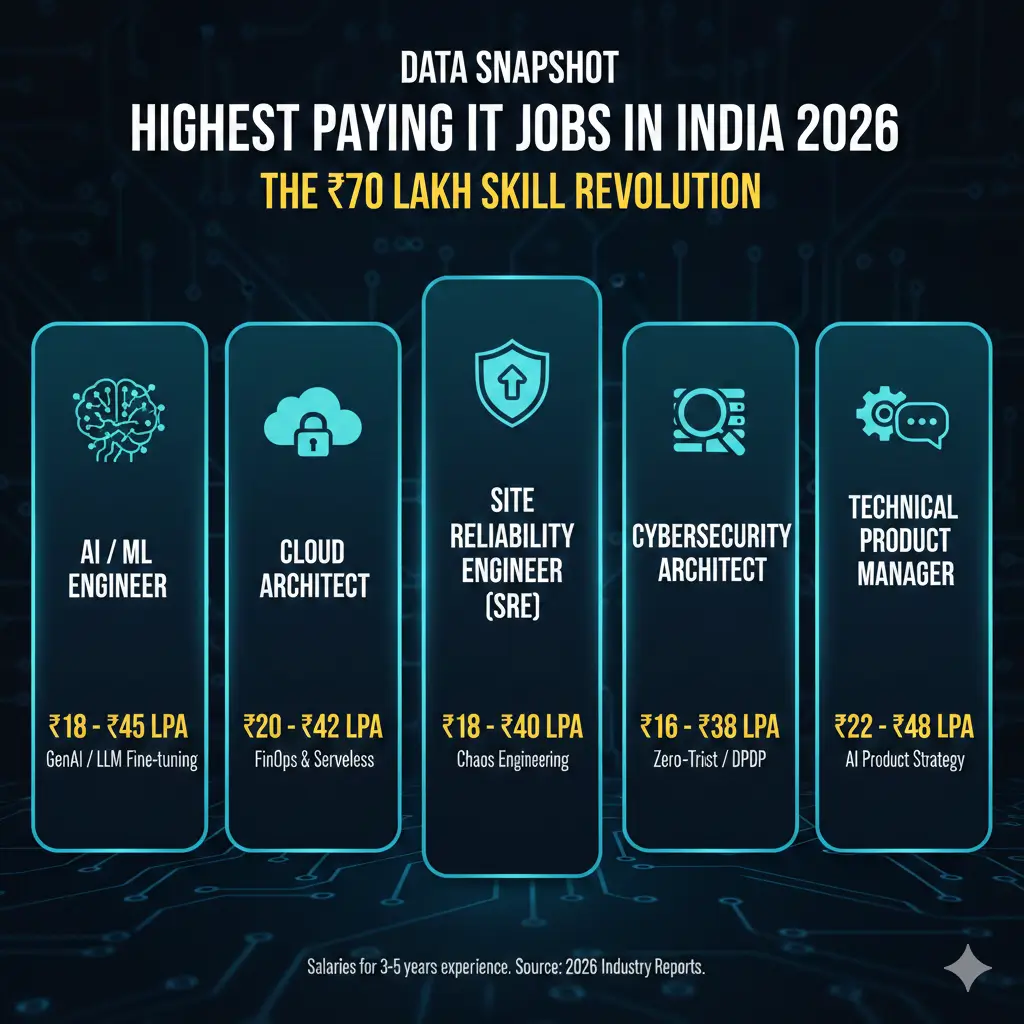
Top 10 Highest Paying IT Jobs in India (2026 Salary Snapshot – Source Benchmarked)
| Rank | Role | Typical Mid-Level | High-End | Market Reality |
|---|---|---|---|---|
| 1 | AI/ML Engineer | ₹12–30 LPA | ₹50–70 LPA | GenAI & MLOps specialists drive premium |
| 2 | Technical Product Manager | ₹18–35 LPA | ₹50–65 LPA | Higher in SaaS & AI-led products |
| 3 | Cloud Architect | ₹18–32 LPA | ₹45–60 LPA | Multi-cloud + FinOps commands premium |
| 4 | Site Reliability Engineer (SRE) | ₹16–30 LPA | ₹45–55 LPA | Kubernetes & reliability at scale |
| 5 | Cybersecurity Architect | ₹15–28 LPA | ₹45–55 LPA | BFSI & compliance-heavy sectors pay more |
| 6 | Data Scientist | ₹14–28 LPA | ₹45–55 LPA | Advanced ML > dashboard analytics |
| 7 | Big Data Engineer | ₹14–26 LPA | ₹40–50 LPA | Kafka + streaming expertise pays more |
| 8 | Blockchain Developer | ₹12–25 LPA | ₹45–60 LPA | Niche skill, high variance |
| 9 | DevOps Engineer | ₹12–26 LPA | ₹38–48 LPA | Platform engineering roles rising |
| 10 | Full Stack Developer | ₹10–22 LPA | ₹35–45 LPA | Higher in product companies |
- Ranges represent metro markets (Bengaluru, Hyderabad, Delhi-NCR).
- Service companies typically pay 15–30% lower than product companies.
- High-end figures reflect stock + performance bonus inclusion.
- Compensation varies based on system design skills, ownership, and niche specialisation.
If you are looking for the fastest route to a high-growth career, these five roles represent the peak of the 2026 market.
Why 2026 is the “Year of the Specialist”?
What distinguishes the current hiring cycle from previous years is a fundamental move toward Global Capability Centres (GCCs). India now hosts over 1,600 Global Capability Centres (GCCs), according to the NASSCOM GCC India Report 2025–26, published by NASSCOM, which projects continued expansion in AI-led engineering hubs across Bengaluru, Hyderabad, and Pune.
| City | Avg. IT Salary (3–6 Yrs) | Premium Sector | Living Cost Index |
| Bengaluru | ₹18 LPA – ₹34 LPA | AI/ML & DeepTech | High |
| Hyderabad | ₹16 LPA – ₹30 LPA | Cloud Infrastructure | Moderate |
| Delhi-NCR | ₹14 LPA – ₹28 LPA | Fintech & EdTech | High |
| Pune | ₹12 LPA – ₹24 LPA | Product Engineering | Moderate |
| Chennai | ₹11 LPA – ₹22 LPA | SaaS & Auto-Tech | Moderate |
The Three Pillars of 2026 Compensation:
- Production-Level Ownership: Employers now value a GitHub portfolio showing real-world deployments more than a Tier-1 degree.
- The “Cloud-Native” Mandate: In 2026, “knowing the cloud” is basic; “optimising cloud costs (FinOps)” is where the high salary lies.
- Regulatory Impact: With the full implementation of India’s Digital Personal Data Protection (DPDP) Act, cybersecurity has moved from a “support cost” to a “strategic priority,” accelerating double-digit salary growth in security-focused roles across BFSI and fintech sectors.
1. AI & Machine Learning Engineering
As the #1 paying role in 2026, AI/ML is no longer about just running scripts; it’s about building scalable intelligence.
- Average 2026 Salary: ₹18 LPA – ₹40 LPA
- The ₹50L+ Outlier: Reserved for engineers who can move models from “Research” to “Hyperscale Production” using MLOps.
- Core 2026 Stack: PyTorch, LangChain, Vector Databases (Pinecone/Milvus), and NVIDIA NIM.
- Top Certification: Google Professional Machine Learning Engineer or AWS Machine Learning – Speciality.
2. Site Reliability Engineer (SRE): The Revenue Protectors
In 2026, downtime isn’t just a technical glitch; it’s a multi-million dollar loss. SREs are the bridge between development and operations, ensuring that hyperscale systems remain resilient.
- Salary Range: ₹18 LPA – ₹38 LPA (3–5 years)
- The ₹50L+ Outlier: Achieving this requires expertise in Chaos Engineering and managing “Blast Radius” for global SaaS platforms.
- Why the Pay is High: SREs carry the “PagerDuty” burden. They are paid for their ability to automate away manual tasks and handle high-pressure incidents.
- 2026 Skill Stack: Go/Rust for systems programming, Kubernetes Operator pattern, and Observability (OpenTelemetry).
- Top Certification: Certified Kubernetes Administrator (CKA) or Google Professional Cloud DevOps Engineer.
3. Cloud Architect: The Strategic Designer
Cloud computing in 2026 has moved past simple “Lift and Shift.” Modern architects design Multi-Cloud and Sovereign Cloud environments that comply with local data laws while optimising for cost.
- Salary Range: ₹20 LPA – ₹40 LPA
- The ₹50L+ Outlier: Found in roles focusing on Cloud FinOps (financial optimisation), where the architect saves the company millions in wasted cloud spend.
- 2026 Skill Stack: Terraform/Pulumi (IaC), Serverless architectures, and Cross-cloud connectivity (AWS + Azure/GCP).
- Top Certification: AWS Solutions Architect – Professional or Azure Solutions Architect Expert.
4. Cybersecurity Engineer: The Compliance Guardians
With the Digital Personal Data Protection (DPDP) Act fully active in India, a data breach is now a legal and existential threat. This has catapulted Security from a back-office function to a boardroom priority.
- Salary Range: ₹14 LPA – ₹32 LPA (3–5 years)
- The ₹50L+ Outlier: Security Architects who can design Zero-Trust Frameworks for BFSI (Banking, Financial Services, and Insurance) or Fintech unicorns.
- Why the Pay is High: There is a massive global shortage of professionals who understand both the “Attack” (Red Teaming) and the “Defence” (Blue Teaming) sides of the fence.
- 2026 Skill Stack: Identity and Access Management (IAM), Cloud Security Posture Management (CSPM), and DevSecOps.
- Top Certification: CISSP (Certified Information Systems Security Professional) or Certified Ethical Hacker (CEH).
5. Technical Product Manager (TPM): The Business-Tech Hybrid
The highest-paid non-coding (or “low-coding”) role in 2026. TPMs are the “CEOs of the Feature,” translating complex AI capabilities into products that users actually want to buy.
- Salary Range: ₹22 LPA – ₹45 LPA
- The ₹50L+ Outlier: Product leaders at SaaS unicorns who own the entire lifecycle of a revenue-generating AI product.
- Core 2026 Stack: SQL for data-driven decisions, Agile/Scrum, and AI-Product Lifecycle Management.
- Top Certification: Pragmatic Institute Product Certification or PMP (if combined with tech experience).
Transitioning to the “Developer” Tier
While Architects and SREs design the systems, the Full Stack and Data Engineers are the ones building the engine. In the next section, we will break down why these roles are seeing a 20% year-on-year salary growth despite the rise of AI-coding tools.
6. Data Scientist: The Insight Engine
Data Science in 2026 has matured beyond simple dashboards. The highest earners are those who specialise in Predictive Modeling and AI-integrated analytics.
- Salary Range: ₹15 LPA – ₹35 LPA (3–5 years)
- The ₹50L+ Outlier: Specialists in Generative AI analytics or those working at top-tier product firms like Google, Amazon, or Fractal Analytics.
- 2026 Skill Stack: Python, Advanced SQL, MLOps, and Deep Learning frameworks (TensorFlow/PyTorch).
- Top Certification: Google Professional Data Engineer or IBM Data Science Professional Certificate.
7. Big Data Engineer: The Pipeline Architects
While Data Scientists analyse data, Big Data Engineers build the “highways” that transport it. With the explosion of IoT and real-time streaming in 2026, these professionals are critical for handling petabyte-scale datasets.
- Salary Range: ₹15 LPA – ₹30 LPA
- The ₹45L+ Outlier: Engineers who can design Real-time Streaming Pipelines using Kafka and Flink for high-frequency trading or live e-commerce platforms.
- 2026 Skill Stack: Apache Spark, Kafka, Snowflake, and Cloud Data Warehousing (BigQuery/Redshift).
- Top Certification: Databricks Certified Data Engineer Professional or AWS Certified Data Engineer – Associate.
8. Blockchain Developer: The Trust Builders
Blockchain has moved past the crypto hype of the early 2020s. In 2026, it is the standard for Supply Chain Transparency, DeFi, and Secure Identity management in India.
- Salary Range: ₹16 LPA – ₹32 LPA
- The ₹60L+ Outlier: Lead developers at Web3 startups or Fintechs who can write high-security Smart Contracts in Solidity or Rust.
- Why the Pay is High: It is a niche field with a high barrier to entry. A single bug in a smart contract can cost millions, making “Security-first” developers incredibly valuable.
- 2026 Skill Stack: Solidity, Rust, Ethereum/Polygon, and Cryptography.
- Top Certification: Certified Blockchain Developer (CBD) or ConsenSys Academy’s Blockchain Developer Bootcamp.
9. Full Stack Developer: The Product Creators
The most versatile role on the list. In 2026, “Full Stack” means more than just HTML and CSS; it requires a deep understanding of Modern Frameworks and Cloud-Native deployment.
- Salary Range: ₹12 LPA – ₹25 LPA (Product Companies)
- The ₹40L+ Outlier: “Product Engineers” who can take a feature from an idea to a scaled, deployed cloud application independently.
- 2026 Skill Stack: Next.js, Node.js, TypeScript, and Tailwind CSS.
- Top Certification: Meta Full Stack Developer Professional Certificate or AWS Certified Developer – Associate.
10. DevOps Engineer: The Automation Experts
DevOps is the “glue” of the modern IT department. In 2026, the focus has shifted toward Platform Engineering, where DevOps engineers build internal tools to help developers move faster.
- Salary Range: ₹12 LPA – ₹28 LPA
- Core 2026 Stack: Jenkins, GitLab CI, Docker, and Infrastructure as Code (Terraform/Ansible).
| Experience Level | Role Title (Example) | 2026 Salary Range (Avg) | Skill Focus |
| Fresher (0–2 Yrs) | Junior Developer / AI Associate | ₹6 LPA – ₹10 LPA | Core Coding & Cloud Basics |
| Mid-Level (3–6 Yrs) | Senior Engineer / SRE | ₹15 LPA – ₹32 LPA | System Design & Automation |
| Lead / Architect (7–12 Yrs) | Solutions Architect / Lead Data Scientist | ₹35 LPA – ₹65 LPA | Strategic Design & Cost Opt. |
| Leadership (12+ Yrs) | CTO / VP of Engineering / Head of AI | ₹75 LPA – ₹1.5 Cr+ | Business Impact & Scaling |
How to Break the ₹50 LPA Ceiling? (The 2026 Strategy)
If you are currently in the ₹15–20 LPA bracket, jumping to ₹50 LPA+ requires more than just “learning a new language.”
- System Design Mastery: Stop thinking about “functions” and start thinking about “systems.” Can your code handle 1 million concurrent users?
- The “Business Impact” Resume: Instead of writing “I used Python,” write “I reduced server latency by 40%, saving the company ₹1.2 Cr annually.”
- GCC Networking: Target Global Capability Centres (like Goldman Sachs, Target, or Walmart Tech in India). Their pay scales often mirror global standards.
In 2026, the highest paying IT jobs in Indiaare no longer reserved just for the “Software Developer.” As the Indian market matures, specialized architecture and leadership roles are seeing the most aggressive salary growth.
11. IoT Architect: The “AIoT” Integrator
In 2026, the Internet of Things (IoT) has evolved into AIoT, where devices don’t just send data—they make decisions at the edge. Architects who can bridge hardware, 5G connectivity, and AI are in extreme demand for Smart Cities and Industrial 4.0 projects.
- Salary Range: ₹14 LPA – ₹30 LPA (3–5 years)
- The ₹45L+ Outlier: Found in Industrial IoT (IIoT) for manufacturing giants or energy sectors where predictive maintenance saves crores in equipment downtime.
- 2026 Skill Stack: Edge AI, 5G Network Slicing, MQTT/CoAP protocols, and Digital Twin modelling.
- Top Certification: Microsoft Certified: Azure IoT Developer Speciality or Aruba Certified Edge Professional.
12. Network Architect: The Cloud-Connectivity Expert
The role of the “Network Engineer” has been reinvented. In 2026, Network Architects designed the SD-WAN and Zero-Trust pipes that keep global GCCs connected to the cloud without latency.
- Salary Range: ₹15 LPA – ₹30 LPA
- The ₹40L+ Outlier: Experts in Multi-Cloud Networking who can ensure seamless, secure data flow between AWS, Azure, and on-premise private clouds.
- 2026 Skill Stack: SD-WAN, Network Function Virtualisation (NFV), SASE (Secure Access Service Edge), and Python for Network Automation.
- Top Certification: Cisco CCNP Enterprise or Aruba Certified Switching Professional (ACSP).
13. Senior Mobile App Developer: The “Super-App” Builder
While “basic” app development is saturated, the demand for Senior Developers who can build high-performance, high-security apps (like FinTech or Super-apps) has spiked.
- Salary Range: ₹12 LPA – ₹28 LPA
- The ₹35L+ Outlier: Developers specialising in Cross-Platform Performance Optimisation or integrating complex AI models directly into mobile devices (On-device AI).
- 2026 Skill Stack: Flutter/React Native for cross-platform, Swift/Kotlin for native, and Mobile DevSecOps.
14. IT Manager / Director: The Strategic Orchestrator
As teams become more distributed and tech-heavy, the “People Manager” has evolved into a Technical Leader. These roles require managing multi-million dollar budgets and 100+ person engineering teams.
- Salary Range: ₹25 LPA – ₹50 LPA (10+ years experience)
- The ₹70L+ Outlier: Directors in large Global Capability Centres (GCCs) overseeing multi-country delivery and digital transformation.
- Core 2026 Stack: Agile at Scale, OKR Management, Financial Cloud Governance (FinOps), and Stakeholder Leadership.
15. Platform Engineer (Internal Developer Platform / IDP Engineer)
Platform Engineering has emerged as one of the fastest-growing high-paying roles in India’s product ecosystem. Unlike traditional DevOps engineers who focus on CI/CD pipelines, Platform Engineers build internal developer platforms (IDPs) that allow teams to deploy securely and independently.
- Salary Range (3–6 Years): ₹18–34 LPA (Product Firms)
- High-End Potential: ₹50–65 LPA in large SaaS companies and Global Capability Centres.
2026 Skill Stack
- Kubernetes (advanced operators)
- Terraform / Pulumi
- Internal Developer Platforms (Backstage)
- Observability (OpenTelemetry)
- Platform security integration
Why It Pays Well?
Companies now optimise for developer velocity. Engineers who reduce deployment friction directly impact business output — making this role revenue-adjacent.
Top 5 Salary-Boosting Certifications for 2026
Certifications in 2026 act as a verified “pay bump.” These percentages represent the average increase in offers when these badges are present.
| Certification | Expected Salary Hike | Best For |
| AWS Solutions Architect (Professional) | 25% – 35% | Cloud Architects / DevOps |
| Certified Kubernetes Administrator (CKA) | 20% – 30% | SRE / Platform Engineers |
| CISSP (Cybersecurity) | 30% – 40% | Security Leaders / Architects |
| Google Professional ML Engineer | 35% + | AI / ML Engineers |
| PMP (Project Management) | 15% – 20% | IT Managers / TPMs |
In 2026, the “Paper Ceiling” has officially cracked. While a degree still acts as a filter for legacy firms (like the big IT service players), the high-paying Product Tech, GCC, and Startup sectors have moved to a “Skills-First” hiring model.
Can You Get a High-Paying IT Job without a Degree in 2026?
Yes. According to workforce insights referenced in the NASSCOM Strategic Review 2026, nearly 20% of specialised AI and Cloud hires are now sourced from non-traditional educational backgrounds, reflecting a strong shift toward skills-first hiring. If you are a self-taught professional, your “Proof of Work” is your new degree.
The “No-Degree” Blueprint to ₹20 LPA+
- Pick a “High-Scarcity” Niche: Don’t just be a “Web Developer.” Specialise in AI Operations (Prompt Engineering 2.0), Cybersecurity Analytics, or Cloud FinOps. These roles value immediate output over academic background.
- Stack Micro-Credentials: Google, Microsoft, and AWS certifications are now viewed by recruiters as “Verified Skills.” Stacking a Certified Kubernetes Administrator (CKA) with an AWS Professional badge often carries more weight than a generic degree.
- Build a “Live” Portfolio: In 2026, a GitHub full of “calculator apps” is ignored. You need Real-World Impact:
- Contribution to a major open-source project.
- A deployed SaaS tool with actual monthly active users.
- A documented “bug bounty” history on platforms like HackerOne.
- Target Startups & GCCs: Early-stage startups and Global Capability Centres are 3x more likely to hire based on technical test performance rather than resume credentials.
Future-Proofing Checklist: Your 2026 Career Audit
The tech market moves in 6-month cycles now. Use this checklist every quarter to ensure your salary keeps climbing.
- Master “Agentic AI”: Can you build AI agents that do things, not just chatbots that say things? (Focus on LangChain, AutoGPT).
- Hybridise Your Skills: The highest earners in 2026 are “T-Shaped”. (e.g., A Developer who understands Marketing Analytics, or a Security pro who understands Legal Compliance).
- Quantify Your Resume: Replace “I know Java” with “I refactored a legacy Java backend that reduced server costs by 30% ($50k/year).”
- Own Your “Digital Brand”: 80% of high-paying roles are filled via the “Shadow Market” (referrals). Keep your LinkedIn and GitHub active—let the recruiters find you.
- Soft Skills for Hard Pay: As AI takes over coding, your value lies in System Design, Team Leadership, and Stakeholder Communication
FAQs
What is the highest paying IT job in India in 2026?
AI/ML Engineers and Technical Product Managers in product firms and GCCs can exceed ₹60–70 LPA with 5–8 years of experience.
Can I earn ₹50 LPA with 5 years of experience?
Yes. Specialised roles like Cloud FinOps Architect, GenAI Engineer, and Security Architect in product companies offer ₹50 LPA+ packages.
Which city pays the highest IT salaries in India?
Bengaluru leads in AI and DeepTech compensation, followed by Hyderabad for Cloud Infrastructure roles.
Are IT salaries higher in product companies or service companies?
Product companies and Global Capability Centres typically offer 20–40% higher compensation compared to traditional IT services firms.
Conclusion: Future-Proofing Your Career in the 2026 Tech Economy
The Indian IT sector in 2026 is no longer a place where you can “wait for a promotion.” It is a dynamic, high-stakes market that rewards specialisation, speed, and system ownership. As we’ve seen, the gap between a standard developer and a high-earning architect isn’t just years of experience; it’s the ability to handle complexity, whether that’s through AI integration, cloud resilience, or zero-trust security.
The rise of Global Capability Centres (GCCs) in cities like Bengaluru and Hyderabad, combined with a 40% surge in fresh graduate hiring for tech-ready roles, means the “ceiling” for IT salaries has never been higher. However, with this opportunity comes a new standard: Skills are the new currency.
Your 2026 Success Roadmap:
- Pivot to “AI-Plus”: Don’t just be an engineer; be an AI-enabled engineer. Whether you are in QA, DevOps, or Product Management, knowing how to leverage LLMs and automation is a non-negotiable requirement for the ₹30 LPA+ bracket.
- Focus on “The Core”: Master the fundamentals of System Design and Cloud Architecture. Tools change, but the principles of building scalable, secure systems remain constant.
- Build Your Proof of Work: In a market that increasingly ignores degrees, your GitHub, your technical blog, and your certifications (AWS, CKA, CISSP) are your most powerful negotiation tools.
The highest paying IT jobs in India for 2026 are within your reach if you treat your career like a product, constantly iterating, upgrading, and delivering value. The demand-supply mismatch for elite talent is your greatest leverage. Which of these 15 roles will you master this year?

Content Strategist | AI Tools Practitioner | Career & Study Abroad Consultant
Sagar Hedau is a content strategist and AI tools practitioner based in Nagpur, India. With 13+ years of experience in career counselling and psychometry, he now works at the intersection of content strategy and no-code AI technology, using tools like Claude, Lovable, LovArt, and Notion AI in his daily workflow. He writes to make AI genuinely accessible for non-technical professionals, students, and business owners who want to build and automate without coding. He also runs an active career counselling practice, helping individuals navigate career decisions with data-backed psychometric analysis.
🌐 sagarhedau.com | 💼 LinkedIn