
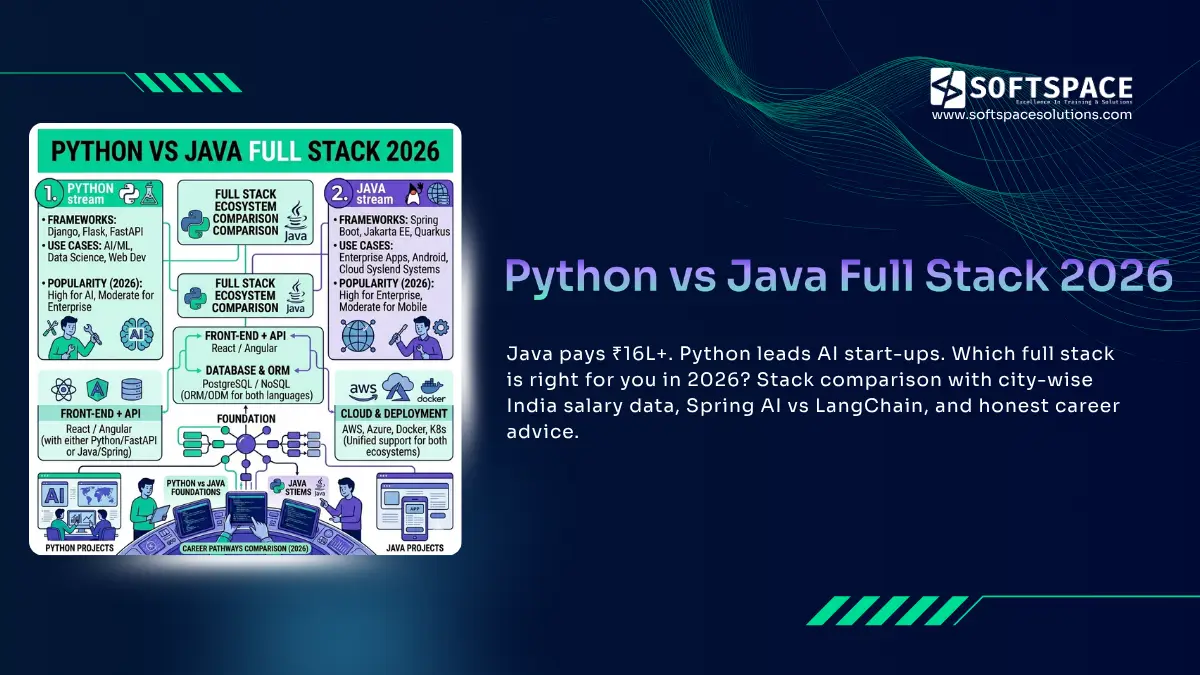
Choosing between Python and Java full stack for development in 2026 depends on one question more than any other: where in the AI ecosystem do you want to work?
Python is the stronger choice if you are building AI-native products, working with agent frameworks like LangChain or CrewAI, or targeting startups and data-driven platforms. Java is the stronger choice if you are entering enterprise environments, financial services, or large IT service firms where Spring Boot and Spring AI are the production standard.
This guide is a 2026 update to the original Python vs Java Full Stack comparison. It adds the AI-integration layer that the previous version did not cover, updates salary data with an AI skill premium, and replaces generic advice with specific use-case guidance for the Indian developer market. It is part of the Full Stack Developer Career Path 2026 content series.
Python vs Java Full Stack at a Glance
Use this table to orient yourself before reading the full breakdown. Each row is covered in detail in the sections below.
| Dimension | Python Full Stack | Java Full Stack |
| Primary AI Framework | LangChain / CrewAI / LlamaIndex | Spring AI |
| Best AI Use Case | Data-centric agents, RAG pipelines, ML-integrated products | Fintech agents, enterprise workflow automation, and banking systems |
| Learning Curve | Gentler — faster first deployment | Steeper — more structured at scale |
| Performance Profile | Strong for prototyping; GIL limits high concurrency | JVM-optimised; excels at 10k+ concurrent workloads |
| Agent Framework Maturity | Very mature — richest ecosystem | Growing fast — Spring AI GA since 2025 |
| Fresher Salary India | ₹4L – ₹8L | ₹4.5L – ₹9L |
| Senior Salary India | ₹18L – ₹40L+ (AI-integrated) | ₹20L – ₹45L+ (AI-integrated) |
| Hiring Volume India 2026 | High — fastest growing in AI/startup roles | Highest overall — dominates IT services sector |
Blue tint = Python advantage. Amber tint = Java advantage. Green tint = AI-premium figures.
What Actually Changed in 2026: The AI Layer Both Stacks Now Need
The 2024 version of this comparison focused on syntax, performance benchmarks, and framework philosophy. Those things are still relevant. But they are no longer the deciding factor for most developers making this choice today.
In 2026, both stacks have an AI integration story. How mature that story is and how naturally it fits the rest of the ecosystem are what actually differentiate them.
Python Gained a Native Moat in AI Development
Python has always been the language of data science and machine learning. What changed in 2025 and 2026 is that the agent framework layer built on top of that foundation became production-ready.
LangChain, CrewAI, LlamaIndex, and Hugging Face are all Python-first. The tooling for building retrieval-augmented generation pipelines, multi-agent orchestration, and vector database integration is more mature, better documented, and more actively maintained in Python than in any other language.
This creates a compounding advantage for Python full-stack developers. When you build a web application in Django or FastAPI, adding an AI layer does not require crossing a language boundary. The same developer who writes the API endpoint writes the LangChain agent that powers it. For a deeper look at how these frameworks compare, the AI and machine learning courses guide covers the learning path for each.
Java Responded with Spring AI
Spring AI reached its first stable release in 2025 and has been adopted quickly across enterprise Java environments. It is not an afterthought bolted onto Spring Boot. It is a first-class integration that allows Java developers to connect Spring applications to any major LLM provider and implement RAG patterns using Java’s existing type system.
For a Java developer already working in a Spring Boot codebase, adding AI features through Spring AI is genuinely straightforward. The ChatClient API, the vector store integrations, and the structured output support all follow Spring’s existing conventions. A Java developer does not need to learn Python to add an AI layer to their application.
The practical implication is that Java’s enterprise dominance is not going to erode quickly because of AI. Banks, insurance companies, and large IT service firms running Java infrastructure have a path to AI integration that does not require rebuilding from scratch.
The IDE Layer Changed for Both
AI-native IDEs like Cursor and Windsurf are language-agnostic tools. A Python developer and a Java developer using Cursor are both getting the same agent-assisted code generation, multi-file reasoning, and inline explanation capabilities.
This means the syntax-level learning curve argument has weakened for both stacks. The real differentiator in 2026 is not which language is easier to learn, but which framework ecosystem gives you the most productive path to building AI features in production.
Performance vs Agility: JVM vs Python Runtime in 2026
Java’s JVM Advantage for Heavy AI Workloads
Java’s compiled bytecode and JVM optimisations give it a measurable edge in latency-sensitive, high-concurrency environments. This matters specifically for AI workloads that require thousands of simultaneous agent calls, real-time fraud detection pipelines, or financial transaction processing, where sub-100ms response times are non-negotiable.
Spring AI’s integration with Java’s reactive programming model through WebFlux enables non-blocking LLM API calls. In high-throughput scenarios, this architecture outperforms Python’s threading model, which is constrained by the Global Interpreter Lock in CPython.
This is not a theoretical distinction. This is why fintech companies processing millions of transactions with AI-assisted decisioning tend to run Java at the core, even when they use Python for the model training layer.
Python’s Advantage in the AI Prototype Cycle
Python’s dominance in NumPy, PyTorch, and the Hugging Face ecosystem means a Python full-stack developer can move from a Jupyter notebook prototype to a deployed FastAPI endpoint in a single sprint without switching languages or contexts.
For startups iterating fast on AI features, this is a measurable productivity advantage. The developer who built the RAG pipeline in a notebook is the same developer who deploys it to production. There is no handoff between a data science team and an engineering team, because the tooling does not require one.
Where the Gap Has Narrowed?
For standard CRUD web applications and REST APIs, the performance difference between Python and Java is negligible in 2026. The gap surfaces at high concurrency, computationally intensive workloads, or AI inference at scale.
Most developers building typical SaaS products or internal tooling will never encounter the ceiling where this matters. Optimising for language performance before you have a product with real users is a premature architectural decision.
AI Agent Scalability: Which Stack Wins for Which Agent Type
This is the section that was entirely missing from the 2024 comparison. Agent architecture is not a generic concept. The right stack for a banking fraud detection agent and the right stack for a social platform content moderation agent are genuinely different.
Why Java Dominates Banking and Fintech AI Agents?
Spring AI’s integration with existing Java enterprise infrastructure means a bank running a 15-year-old Spring MVC application can add an AI agent layer without a full rebuild. That is not a minor convenience. It is the difference between a six-month project and a six-year migration.
The compliance, auditing, and transaction integrity requirements of fintech applications align naturally with Java’s strong typing, ACID database guarantees, and mature Spring Security framework. When a fraud detection agent makes a decision, every step of that decision needs to be logged, auditable, and reversible. Java’s ecosystem has 20 years of tooling built for exactly this requirement.
Specific agent types where Java is the clear choice: loan approval workflow agents, fraud detection agents, regulatory reporting agents, and trade settlement systems with AI-assisted exception handling.
Why Python Leads for Data-Centric and Social Platform Agents?
Python’s native integration with pandas, NumPy, and vector databases makes it the strongest choice for agents that reason over data. Recommendation engines, content moderation agents, personalisation systems, and semantic search agents all sit in a territory where Python’s toolchain has no serious equivalent in Java.
The ability to use the same language across data pipelines, model training, and agent serving reduces the number of language boundaries in a production system. Every language boundary is a potential failure point, a maintenance burden, and an onboarding cost for new developers.
Specific agent types where Python is the clear choice: product recommendation agents, document analysis pipelines, social media content moderation, customer support agents with RAG-based knowledge retrieval, and scientific research automation.
The Hybrid Reality
Some mature engineering teams run Python for the AI and data layer and Java for the transaction processing layer, with clean API boundaries between them. This is not a failure of the comparison. It is an honest reflection of how large production systems are actually built.
For most individual developers or small teams making a stack choice, the hybrid model is not a realistic starting point. Choose the stack that matches your primary use case and treat the other as a secondary skill to develop over time.
The Practitioner’s Take: What This Looks Like From the Ground?
This section reflects the author’s direct experience working at the intersection of AI tooling and career strategy, not general research.
Most developers asking this question are not choosing between two equally viable paths. They are trying to identify which path has the better risk-adjusted outcome for their specific situation in India in 2026.
Python developers are building the tools that are reshaping the industry. When you work in LangChain, CrewAI, or Hugging Face, you are working in the same ecosystem that is producing the AI products hiring managers want to discuss in interviews. There is a cultural alignment between Python and the current wave of AI development that Java does not yet have at the same depth.
Java developers, on the other hand, are not being displaced. The enterprise sector in India, particularly BFSI (banking, financial services, and insurance), is not going to migrate away from Java infrastructure in this decade. The developers who add Spring AI to a strong Spring Boot background in 2026 are positioning themselves for some of the most secure and well-compensated roles in the Indian IT market.
The disruption risk is real for both stacks, but it looks different. Python developers face a market where AI tools can generate competent Python code faster than ever, which raises the bar for what counts as a meaningful skill signal. Java developers face a market where service company roles are being compressed by productivity tools, but enterprise product roles remain strong.
“Whichever stack you choose, the AI integration layer on top of it is not optional in 2026. A Python developer without LangChain experience and a Java developer without Spring AI experience are both leaving the most significant salary premium on the table.”
For more on how AI is reshaping the developer job market in India specifically, the AI career survival guide for India 2026 addresses the disruption question with more depth than this article can accommodate.
The 2026 Salary Gap: India Market Data with AI Skill Premium
The most important update to the salary picture in 2026 is the AI skill premium column. The difference between a standard full-stack salary and an AI-integrated full-stack salary has widened to 30 to 60% at every experience level. That gap is more significant than the gap between Python and Java base salaries.
Salary by Experience Level
The green-shaded columns reflect market rates for developers who can demonstrate production AI integration skills, meaning deployed projects using LangChain, Spring AI, RAG systems, or vector database architecture.
| Experience | Python Full Stack | Java Full Stack | Python + AI | Java + AI |
| 0 to 2 yrs | ₹4L – ₹8L | ₹4.5L – ₹9L | ₹6L – ₹12L | ₹7L – ₹13L |
| 3 to 5 yrs | ₹10L – ₹18L | ₹11L – ₹20L | ₹16L – ₹28L | ₹18L – ₹32L |
| 6+ yrs | ₹20L – ₹38L | ₹22L – ₹42L | ₹32L – ₹55L+ | ₹35L – ₹60L+ |
Java holds a slight overall edge in base salary at every tier, driven by enterprise demand and the higher average company size of Java employers. Python matches or exceeds Java in the AI-integrated columns at senior levels in product companies and funded startups.
Salary by City
Bangalore and Hyderabad show the highest AI skill premiums because of startup and product company density. Chennai and Pune show stronger Java enterprise premiums because of the concentration of IT services and BFSI employers.
| City | Python FS (3-5 yrs) | Java FS (3-5 yrs) | Python + AI | Java + AI |
| Bangalore | ₹12L – ₹22L | ₹13L – ₹24L | ₹22L – ₹38L | ₹24L – ₹42L |
| Hyderabad | ₹11L – ₹20L | ₹12L – ₹22L | ₹20L – ₹34L | ₹22L – ₹38L |
| Mumbai | ₹11L – ₹20L | ₹12L – ₹22L | ₹19L – ₹33L | ₹21L – ₹36L |
| Pune | ₹10L – ₹18L | ₹11L – ₹20L | ₹17L – ₹30L | ₹19L – ₹33L |
| Delhi NCR | ₹10L – ₹18L | ₹11L – ₹20L | ₹17L – ₹30L | ₹19L – ₹33L |
| Chennai | ₹9L – ₹16L | ₹10L – ₹18L | ₹15L – ₹26L | ₹16L – ₹28L |
These figures are based on market data from AmbitionBox, LinkedIn Salary Insights, and Glassdoor India as of Q1 2026. They represent typical ranges for developers with relevant project experience, not maximum or guaranteed figures.
For a broader view of IT compensation across roles, the highest paying IT jobs in India and AI engineer salary trends 2026 provide full breakdowns.
The AI Skill Premium Explained
A developer with three to five years of experience but with a deployed AI integration project in their portfolio commands 30 to 60% above the base salary range for their stack and experience level.
The premium exists because supply has not caught up with demand. Most mid-level developers working in 2026 learned their stack before production-grade agent frameworks were widely available. They have the web development fundamentals, but not the AI integration layer. Employers are paying to close that gap.
This premium will compress over time as more developers acquire these skills. The window where it represents a genuine salary jump is estimated at 18 to 24 months from now, based on the pace of curriculum adoption in Indian engineering colleges and bootcamps.
Hiring Volume and Job Market Shape
Java full-stack roles are more numerous in aggregate because of the scale of India’s IT services sector. Firms like TCS, Infosys, Wipro, and Capgemini collectively hire tens of thousands of Java developers annually. For context on which companies pay the most, the best paying companies for software engineers resource covers compensation benchmarks across major employers.
Python full-stack roles are growing faster in percentage terms. Funded AI startups, product companies, and global capability centres building AI-native products are overwhelmingly specifying Python in job descriptions. The growth trajectory favours Python for the next three to five years.
Learning Path: Which Stack Gets You Hired Faster in 2026
If You Are Starting From Zero
Python is the faster path to a first interview. The syntax is simpler. The Django and FastAPI ecosystems are more beginner-friendly than Spring Boot. The free learning resources for Python AI development are better maintained and more current.
Estimated time to a first junior developer interview with consistent daily practice of two to three hours: eight to ten months. This assumes completing a foundation course, building two projects with at least one deployed live, and preparing for technical interviews.
The free full-stack developer courses 2026 guide covers the best free Python and Java learning paths currently available, with honest assessments of what each course will and will not prepare you for.
If You Already Know Java
Adding Spring AI to an existing Java full-stack background is one of the highest-ROI skill upgrades available to a Java developer in 2026. Spring Academy’s free tier covers the Spring AI framework with enough depth to build a production RAG application.
A Java developer who builds one Spring AI project, can explain its architecture in an interview, and has it deployed to a live URL, is positioned ahead of most Java candidates currently in the market. The gap between “Java developer who knows Spring Boot” and “Java developer who knows Spring AI” in salary terms is approximately the AI skill premium figures shown in the table above.
The AI-Assisted Learning Caveat
AI-native IDEs have compressed the syntax learning curve for both languages. A developer learning Python with Cursor assistance in 2026 is moving faster through the fundamentals than one learning from documentation alone in 2022.
This does not change the stack recommendation, but it does make the timelines above achievable for motivated learners in a way they were not previously. What it does not compress is the time required to build judgment about architecture decisions, debugging agent behaviour, and understanding what the generated code is actually doing. That still requires deliberate practice.
The Head-to-Head Verdict: Choose Your Stack for 2026
Most comparison articles end here with “it depends.” That is not useful. Here is a direct recommendation based on specific scenarios.
Choose Python Full Stack If
- You are targeting AI startups or product companies: Python is the default language of India’s AI startup ecosystem. Being Python-native is a genuine hiring advantage at funded companies building AI-first products.
- You want to work with agent frameworks directly: LangChain, CrewAI, and LlamaIndex are Python-first. If building agents is the goal, Python removes one layer of friction.
- You are coming from a data science or analytics background: The transition from pandas and NumPy to Django or FastAPI is smoother than switching to Java. You can leverage existing Python knowledge.
- You are a complete beginner prioritising speed to employment: Python’s gentler learning curve and richer beginner ecosystem give you a faster path to a first junior role.
- You want to freelance or build a product: Python’s deployment ecosystem, combined with low-code tools like Lovable that generate Python-compatible backends, gives you the fastest path from idea to working product.
Choose Java Full Stack If
- You are targeting BFSI or large enterprise roles: Banking, insurance, and large IT service firms run Java. Being Java-native is a direct hiring advantage at the companies offering the most stable, well-compensated roles in the Indian market.
- You are already a Java developer looking to upskill: The Spring AI upgrade is far more efficient than switching to Python. Your existing Java and Spring knowledge compounds. Do not throw it away.
- You are building systems that require high concurrency or strict compliance: Java’s JVM performance, ACID guarantees, and mature security tooling make it the more defensible choice for systems where reliability has regulatory consequences.
- You prefer strongly-typed languages and structured codebases: Java’s type system catches more errors at compile time. For large teams maintaining complex codebases over many years, this is a genuine advantage over Python’s dynamic typing.
- Your target employers run legacy Java infrastructure: If the companies you want to work for have 10-year-old Spring MVC applications that need to be extended, knowing Java is the entry ticket.
The Honest Middle Ground
For roughly 40% of full-stack developer roles in India in 2026, the stack choice is genuinely interchangeable. Standard SaaS products, internal tooling, and mid-market web applications can be built competently in either stack.
In these cases, the real differentiator is not Python versus Java. It is the AI integration skill layer on top of whichever stack you choose. A Python developer with LangChain experience and a Java developer with Spring AI experience are both well-positioned. A developer in either stack without any AI integration skills is increasingly competing on the same ground as AI-generated code.
The highest paying programming languages in India post provides additional salary context across languages beyond just Python and Java, which is useful if you are still weighing the broader landscape.
Frequently Asked Questions: Python vs Java Full Stack
-
Is Python or Java better for full stack development in India in 2026?
Python is better if you are targeting AI-native startups, data-driven products, or roles that involve agent frameworks like LangChain or CrewAI. Java is better if you are targeting enterprise companies, BFSI roles, or large IT service firms running Spring Boot infrastructure. Both are actively hiring in India in 2026. The AI skill premium applies to both stacks equally, meaning the most important decision is not Python versus Java but whether you add AI integration skills on top of whichever you choose.
-
Which full stack is better for AI agent development in 2026?
Python has a significant advantage for AI agent development in 2026. LangChain, CrewAI, LlamaIndex, and the Hugging Face ecosystem are Python-first. The agent framework tooling is more mature, better documented, and more actively maintained than its Java equivalents. Java’s Spring AI is a serious and growing option for developers who need to add agent capabilities to existing Java enterprise applications, but it does not yet match the breadth of Python’s agent ecosystem.
-
What is the salary difference between Python and Java full stack developers in India?
Java full-stack developers earn a slight base salary premium across all experience levels in India, typically 5 to 10% above equivalent Python developers. This reflects Java’s dominance in enterprise and BFSI roles, which tend to offer higher compensation than startup roles. The more significant salary variable in 2026 is the AI skill premium. A Python or Java developer with demonstrable AI integration experience commands 30 to 60% above the standard salary range for their experience level and stack. The full breakdown by experience tier and city is in the salary section above.
-
Should a fresher learn Python full stack or Java full stack in 2026?
Python is the recommended starting point for most freshers in 2026. The learning curve is gentler, the free learning resources are more current, and the AI frameworks that are generating the strongest demand in product companies are Python-first. Python also offers a faster path from learning to a first deployed project, which is the most important portfolio signal for a fresher in the current market. The exception is if you have a specific goal of working at a large IT service firm or in BFSI, in which case Java’s dominance in those sectors makes it the more efficient entry route.
-
Can I use both Python and Java in the same full stack application?
Yes, and some mature production systems do exactly this. A common architecture runs Python for the AI, data processing, and model inference layers, with Java handling the transaction processing, compliance, and core business logic layers. The two stacks communicate through REST APIs or message queues. This is not a recommended starting point for individual developers or small teams. It adds infrastructure complexity and onboarding cost. Start with one stack, build proficiency, and consider a polyglot architecture only when a specific technical requirement genuinely demands it.
-
How does Spring AI compare to LangChain for full stack developers?
LangChain is more mature and has a richer ecosystem of integrations, tools, and community resources. It is Python-first and benefits from Python’s dominant position in the AI/ML toolchain. Spring AI is newer but follows Spring’s established conventions closely, which makes it more approachable for Java developers than LangChain would be. For building production RAG applications, LangChain has more reference implementations and community-tested patterns. For integrating AI into an existing Java enterprise application without leaving the Java ecosystem, Spring AI is the more practical choice. The comparison is less about which is objectively better and more about which ecosystem you are already working in.
Conclusion
Python and Java are both viable full-stack choices in 2026. They are not equally suited to every situation. Python is the stronger choice for AI-native development, startup environments, and data-centric products. Java is the stronger choice for enterprise infrastructure, BFSI roles, and high-concurrency systems that require strict compliance guarantees.
The salary data shows Java holding a slight overall edge at the base level. The AI skill premium data shows that edge eroding or reversing entirely for developers in both stacks who invest in AI integration skills.
For the complete learning architecture around both stacks, including which courses to take, how to build a portfolio, and what the career progression looks like, the Full Stack Developer Career Path 2026 pillar post is the next resource to read. For free course options in both Python and Java, the free full-stack developer courses 2026 guide covers the current best options with honest assessments.

Content Strategist | AI Tools Practitioner | Career & Study Abroad Consultant
Sagar Hedau is a content strategist and AI tools practitioner based in Nagpur, India. With 13+ years of experience in career counselling and psychometry, he now works at the intersection of content strategy and no-code AI technology, using tools like Claude, Lovable, LovArt, and Notion AI in his daily workflow. He writes to make AI genuinely accessible for non-technical professionals, students, and business owners who want to build and automate without coding. He also runs an active career counselling practice, helping individuals navigate career decisions with data-backed psychometric analysis.
🌐 sagarhedau.com | 💼 LinkedIn