
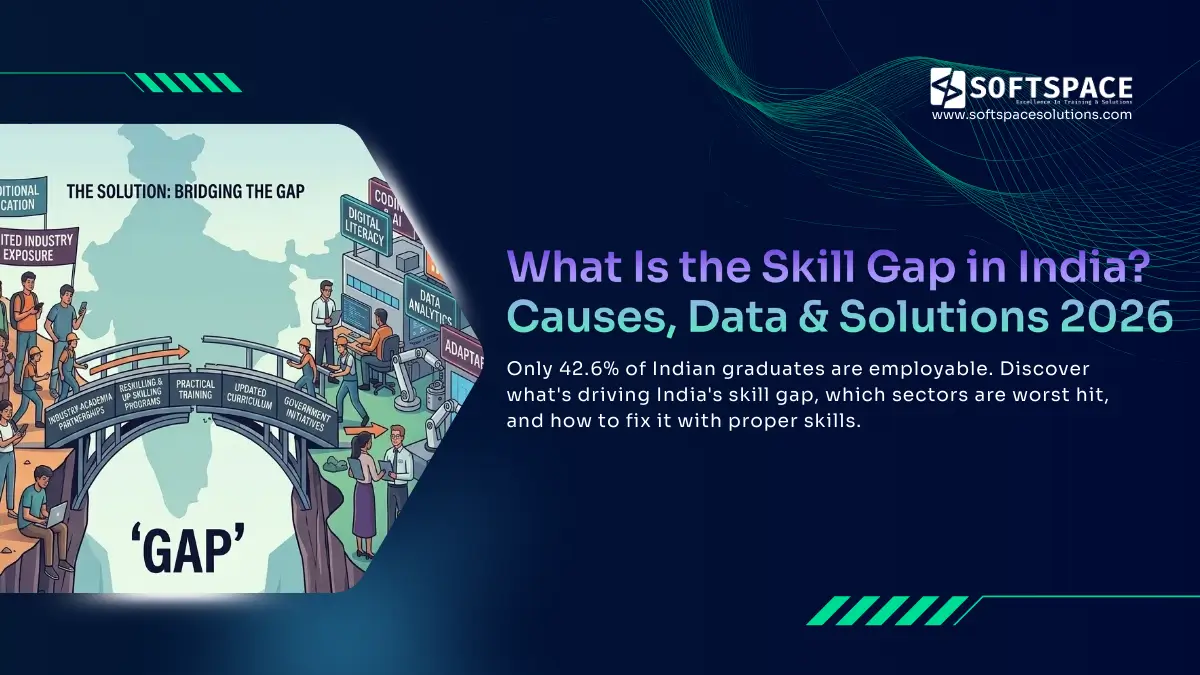
What is the skill gap in India? This discussion refers to the critical mismatch between the evolving skills required by employers and the actual competencies possessed by the workforce. Driven by the rapid advancements in artificial intelligence, automation, and digital transformation, this gap currently leaves only 42.6% of Indian graduates employable, according to the Wheebox 2025 report.
With 82% of employers reporting difficulty in finding right-fit talent, India faces a projected deficit of 47–49 million skilled workers by 2027. Addressing this crisis requires a whole-of-society response, including modernising the theory-heavy education system, expanding vocational training through initiatives like PMKVY, and fostering industry-academia collaboration to ensure the nation’s vast demographic dividend becomes an economic asset
Table of Contents
What is the skill gap in India? (Latest Statistics 2024–2026)
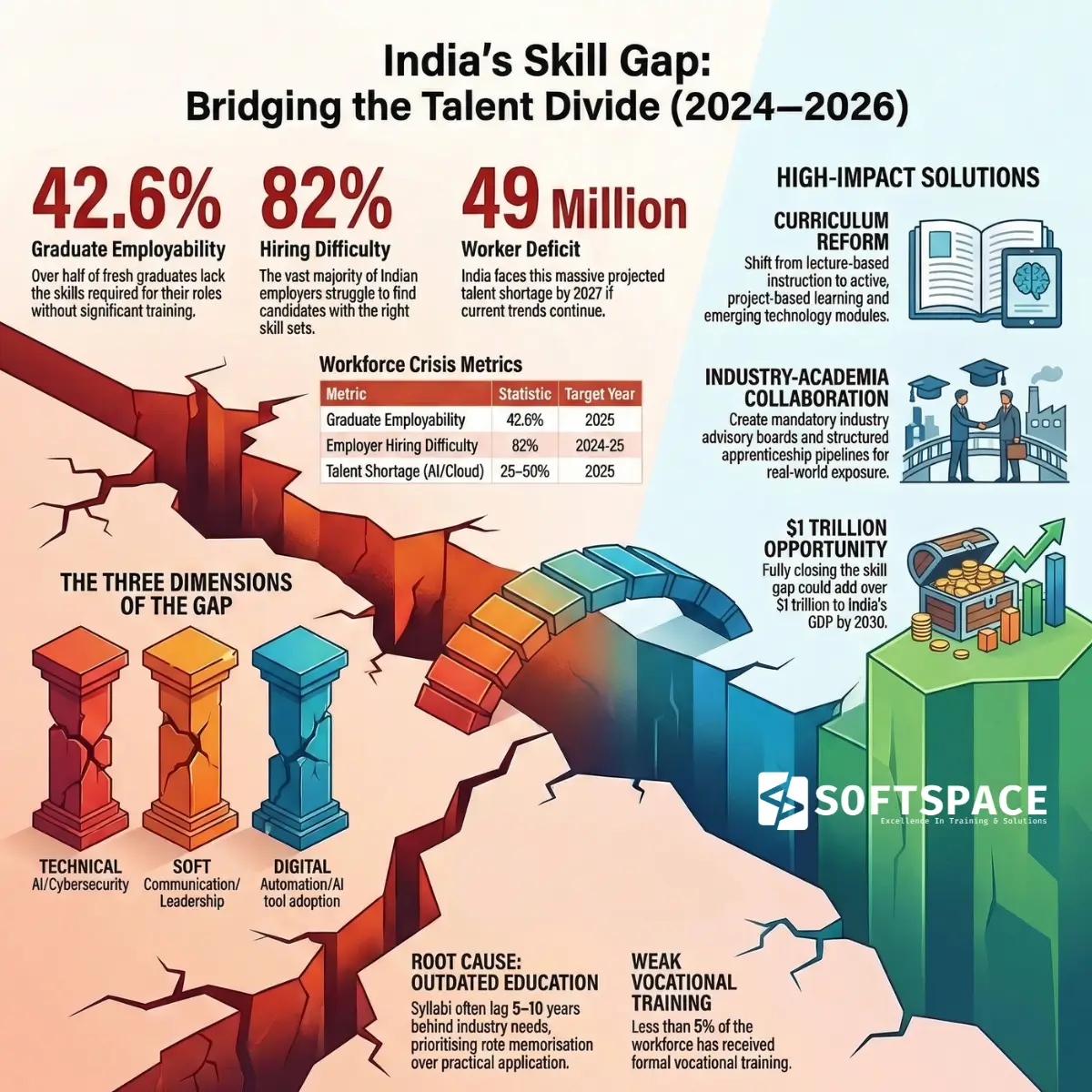
Data paints a sobering picture of India’s workforce readiness crisis. The following statistics, drawn from authoritative industry reports, government surveys, and global talent indices, reveal just how acute the skill deficit has become.
- Only 42.6% of Indian graduates are considered employable, according to the Wheebox ETS India Skills Report 2025, meaning more than half of all fresh graduates lack the skills required to perform their intended roles without significant additional training.
- 82% of employers in India report difficulty finding candidates with the right skill sets, highlighting a critical disconnect between educational output and real-world industry needs.
- India faces a potential workforce skill deficit of 47–49 million workers by 2027, according to projections by the National Skill Development Corporation (NSDC) and the World Economic Forum.
- 91.94% of Indian adolescents have had no formal skill training exposure, leaving the next generation of workers unprepared even before entering the workforce.
- AI, cloud computing, and cybersecurity roles face a 25–50% talent shortage, as per Nasscom and LinkedIn’s 2024–25 talent reports, with demand far outpacing the available skilled pipeline.
The table below summarises these key data points:
| Metric | Statistic | Source / Year |
| Graduate employability | 42.6% | Wheebox ETS India Skills Report 2025 |
| Employers are struggling to hire | 82% | India Employer Survey 2024–25 |
| Workforce skill shortage by 2027 | Up to 49 million workers | NSDC / World Economic Forum |
| Adolescents with formal skill training | < 8.06% (91.94% without) | NSSO / NSDC Data |
| Tech talent shortage (AI/Cloud/Cyber) | 25–50% | Nasscom / LinkedIn 2024–25 |
What Is the Skill Gap in the Indian Workforce?
The skill gap in India’s workforce is not a single, uniform problem; it manifests across three distinct but interconnected dimensions: technical skills, soft skills, and digital skills. Each presents unique challenges and requires tailored solutions.
3.1 Technical Skill Gap
The technical skill gap is most visible in high-growth sectors where specialised knowledge is critical. Industries requiring expertise in artificial intelligence (AI), cloud computing, data science, and cybersecurity are facing acute shortages that are slowing innovation and growth.
- Artificial Intelligence & Machine Learning: Despite India’s reputation as a tech powerhouse, fewer than 10% of AI job applicants have the practical skills needed for deployment-ready roles.
- Cloud Computing: Rapid cloud adoption by enterprises is outpacing the supply of certified cloud architects and engineers.
- Data Science & Analytics: While data literacy is growing, roles requiring advanced statistical modelling and machine learning remain severely understaffed.
- Cybersecurity: India faces a shortage of over 790,000 cybersecurity professionals, even as digital infrastructure expands rapidly.
3.2 Soft Skills Gap
Beyond technical capabilities, Indian employers consistently cite a deficit in foundational professional competencies. These ‘human’ skills are increasingly important as AI automates routine technical tasks.
- Communication: Many graduates struggle to communicate effectively in professional settings, particularly in English, which remains the dominant language of business.
- Critical Thinking & Problem Solving: Rote-learning-heavy curricula leave many graduates underprepared for roles that require analytical reasoning and independent decision-making.
- Leadership & Collaboration: Teamwork, adaptability, and the ability to manage cross-functional relationships are consistently rated among the most lacking attributes in entry-level hires.
3.3 Digital Skills Gap
As India’s economy rapidly digitises, digital literacy has become a baseline requirement across virtually every industry. Yet this remains one of the widest gaps in the workforce.
- Automation Readiness: Workers in manufacturing, logistics, and services are insufficiently trained to work alongside automated systems and robotics.
- AI Tool Adoption: Most employees outside IT lack even basic proficiency in using AI-powered productivity tools now standard in global workplaces.
- Digital Literacy in Rural Areas: The urban-rural divide in digital skills access creates a two-tiered workforce, with rural workers at serious risk of being left behind.
4. Why India Has a Skill Gap (Core Causes)?
Understanding why India has a skill gap requires examining the structural, systemic, and socioeconomic factors that have produced and perpetuated this crisis over decades.
4.1 Outdated Education System
India’s formal education system was largely designed for an industrial-era economy. Despite decades of reform efforts, the curriculum at most universities and colleges remains heavily theory-focused, with limited emphasis on applied learning, industry exposure, or emerging technologies.
- Syllabi at many institutions lag 5–10 years behind current industry requirements.
- Practical laboratory work, live projects, and real-world problem-solving are insufficiently integrated into most degree programmes.
- Assessment systems reward memorisation over innovation, producing graduates who know information but cannot apply it.
4.2 Weak Industry-Academia Collaboration
One of the most persistent structural causes of the skill gap is the limited and often transactional nature of relationships between educational institutions and industry.
- Most universities design curricula without meaningful input from employers, resulting in graduates trained for jobs that no longer exist or that fail to reflect current market demands.
- Internship and apprenticeship programmes are inconsistent in quality and availability, particularly outside of premier institutions such as the IITs and IIMs.
- Faculty often lack industry experience, limiting their ability to bridge the gap between theory and practice.
4.3 Lack of Vocational Training
India has historically underinvested in vocational and technical education. In countries like Germany and South Korea, vocational training and skills-based IT certification programs are a prestigious and well-funded pathway. In India, it is often seen as a last resort, underfunded, and disconnected from market needs.
- Less than 5% of India’s workforce has received formal vocational training, compared to 60–80% in many developed economies.
- Industrial Training Institutes (ITIs) and polytechnics frequently suffer from outdated equipment, undertrained instructors, and poor placement outcomes.
4.4 Rapid Technological Change
The pace of technological disruption has accelerated faster than any education system can naturally adapt to. AI, robotics, and automation are reshaping entire job categories within the span of a few years.
- Roles that were common and stable five years ago are now being automated or fundamentally transformed.
- New job categories such as prompt engineering, AI ethics, and green energy management are emerging faster than training infrastructure can respond.
- Technology cycles are now so short that skills can become obsolete even before a degree programme is completed.
4.5 Regional and Socioeconomic Inequality
India’s skill gap is not evenly distributed. Significant disparities exist between urban and rural areas, between different states, and across socioeconomic groups.
- Students in rural and semi-urban areas have access to far fewer quality educational institutions, skilled teachers, and digital infrastructure.
- The digital divide means that rural youth are excluded from the online learning ecosystem that is increasingly the primary vehicle for skills development.
- Students from economically disadvantaged backgrounds often cannot afford the additional coaching or certifications required to compete with their better-resourced peers.
4.6 Poor Career Guidance
A widespread lack of structured career counselling and vocational guidance leaves millions of students making poorly informed decisions about their education and career paths.
- Most schools and colleges in India lack professional career counsellors, leaving students to rely on family networks or peer advice.
- Awareness of high-demand careers in emerging sectors such as cybersecurity, data science, or green technology remains very limited outside major urban centres.
- Students often pursue traditional degree programmes (engineering, medicine, law) without understanding market saturation or future demand trends.
5. Industries Facing the Biggest Skill Shortage in India
While the skill gap touches virtually every sector of the Indian economy, certain industries are experiencing particularly acute shortages that are limiting growth and competitiveness.
5.1 IT & Emerging Technologies
India’s IT sector, long the backbone of the country’s export economy, is facing a paradoxical crisis: even as it generates enormous demand for talent, the available pool of truly job-ready candidates is shrinking relative to need.
- Artificial Intelligence & Machine Learning: The demand for professionals capable of building, training, and deploying AI models has surged, but the talent pipeline remains severely constrained.
- Cloud Computing: As enterprises accelerate cloud migration, the shortage of certified cloud professionals (AWS, Azure, GCP) has become one of the most critical bottlenecks.
- Cybersecurity: With India experiencing a dramatic rise in cyberattacks, the shortage of skilled security professionals poses a significant risk to both businesses and critical national infrastructure.
- Full-Stack Development: Even in more established roles, the ability to work across both front-end and back-end systems remains scarcer than demand warrants.
5.2 Manufacturing & Semiconductor Industry
As India pursues its ambition to become a global manufacturing hub, particularly in semiconductors, electronics, and defence, the absence of a sufficiently skilled technical workforce is a critical constraint.
- The semiconductor industry requires highly specialised engineers in chip design, fabrication, and testing areas, where India has historically had very limited educational infrastructure.
- Precision manufacturing, quality control, and advanced robotics operations require technical skills that most ITIs and polytechnics are not yet equipped to deliver.
- Government initiatives like the PLI (Production Linked Incentive) scheme are attracting foreign investment, but the human capital to support this growth remains underdeveloped.
5.3 Healthcare
India faces a chronic shortage of healthcare professionals, a gap that was dramatically exposed during the COVID-19 pandemic and has not been adequately addressed since.
- With just 0.7 physicians per 1,000 people (well below the WHO-recommended 1:1,000 ratio), India’s healthcare system is critically understaffed.
- Nursing, physiotherapy, medical imaging, and allied health roles face significant shortages, particularly in rural and semi-urban areas.
- The rapid adoption of healthcare technology, including telemedicine, AI diagnostics, and electronic health records, requires a new class of digitally literate health professionals.
5.4 Renewable Energy
As India accelerates towards its ambitious target of 500 GW of renewable energy capacity by 2030, the demand for skilled workers in solar, wind, and green hydrogen is growing exponentially.
- Solar installation, maintenance, and project management roles require workers trained in electrical engineering, smart grid systems, and safety protocols, skills that current programmes are only beginning to address.
- Green energy also requires a new generation of policy, finance, and project management professionals familiar with sustainability frameworks.
5.5 Construction & Infrastructure
India’s massive infrastructure push spanning roads, railways, airports, smart cities, and urban housing demands a workforce capable of managing increasingly sophisticated projects.
- Skilled workers in civil engineering, project management, BIM (Building Information Modelling), and sustainable construction practices are in critically short supply.
- The construction sector is also experiencing a significant ‘mid-level’ skill gap, with shortages among site supervisors, quality managers, and safety officers.
6. Impact of the Skill Gap on India’s Economy
The consequences of India’s skill gap extend far beyond individual unemployment. They represent a systemic drag on the country’s economic potential, innovation capacity, and long-term competitiveness.
- Higher Graduate Unemployment: India’s youth unemployment rate has remained stubbornly high, with millions of graduates unable to secure employment commensurate with their qualifications. The mismatch between graduate supply and employer demand is a primary driver.
- Slower Innovation & Productivity: Businesses unable to access the talent they need innovate more slowly, invest less in R&D, and operate at lower productivity levels, undermining India’s ambition to become a global innovation leader.
- Rising Recruitment Costs: Companies spend increasing resources on extended hiring cycles, assessment, and remedial training programmes to bring new hires up to the required standard. This cost burden disproportionately affects small and medium enterprises (SMEs).
- Productivity Challenges: Employees placed in roles for which they are not adequately skilled deliver lower output quality, make more errors, and require closer supervision, reducing overall organisational efficiency.
- Lost Demographic Dividend: Perhaps the most significant long-term risk is the squandering of India’s demographic dividend. The ‘window’ during which a young, large working-age population can drive economic growth is finite. Failure to skill this workforce in time will have lasting and irreversible economic consequences.
Economists estimate that fully closing India’s skill gap could add over $1 trillion to the country’s GDP by 2030. Investing in skill development is one of the highest-return policy priorities available.
7. Government Initiatives to Reduce the Skill Gap
Recognising the urgency of the crisis, the Government of India has launched a range of programmes and institutions aimed at closing the skill gap and building a more employment-ready workforce.
Skill India Mission
Launched in 2015, the Skill India Mission is the flagship government initiative to train over 400 million Indians in industry-relevant skills by 2022 (now extended). It serves as the umbrella framework for most skill development programmes and coordinates efforts across multiple ministries.
Pradhan Mantri Kaushal Vikas Yojana (PMKVY)
The PMKVY is India’s largest skill certification scheme, providing free short-duration training to youth across a wide range of sectors. By 2025, the programme had enrolled over 14 million beneficiaries across thousands of training centres nationwide. PMKVY 4.0 places greater emphasis on digital and emerging technology skills.
Digital India
While broader in scope than pure skills development, the Digital India initiative plays a critical role in expanding digital infrastructure, internet connectivity, and e-governance, all of which are prerequisites for digital skill development, particularly in rural areas.
National Skill Development Corporation (NSDC)
The NSDC operates as a public-private partnership to catalyse the skill training ecosystem. It funds and partners with private sector training providers, sets quality standards, and runs the internationally recognised Skill India Digital Hub platform.
National Apprenticeship Promotion Scheme (NAPS)
NAPS incentivises companies to take on apprentices by reimbursing a portion of the stipend cost. Despite modest uptake, it represents an important pathway for on-the-job skills development, particularly in manufacturing and engineering sectors.
Policy Note: Despite significant investment, implementation challenges, including low awareness, inconsistent training quality, and weak industry linkages, have limited the impact of these programmes. Scaling quality, not just quantity, remains the central challenge for government skill initiatives.
8. How Companies Are Addressing the Skill Gap
Unable to wait for systemic educational reform, many Indian and multinational companies operating in India have taken skill development into their own hands. A range of corporate strategies has emerged.
- Corporate Upskilling Programmes: Major employers, including Infosys, TCS, Wipro, and Accenture, have invested heavily in internal learning platforms that reskill existing employees in emerging technologies. Infosys’ Lex platform, for example, offers AI-curated learning paths to over 300,000 employees.
- University Partnerships: Companies are increasingly partnering with universities to co-design curricula, offer guest lectures, sponsor research, and create industry-integrated learning programmes, effectively building their own talent pipelines from within the academic system.
- Skills-Based Hiring: A growing number of employers are moving away from degree-based screening in favour of skills assessments, portfolio reviews, and practical challenges. This broadens the talent pool and incentivises candidates to develop demonstrable skills.
- Internal Training Academies: Companies like Amazon, Google, and Mahindra have established dedicated training academies and boot camps that bring new hires to job-readiness within weeks of joining, treating the gap as a solvable onboarding challenge rather than a deal-breaker.
- Industry-Led Certification: Partnerships with global certification bodies (AWS, Google, Microsoft, CompTIA) have made industry-recognised credentials more accessible to Indian workers, providing an alternative credentialing pathway outside traditional university degrees.
9. Solutions to Bridge the Skill Gap in India
Addressing India’s skill gap requires action across multiple fronts simultaneously. The following solutions, drawn from best global practices and adapted to India’s specific context, represent the most actionable and high-impact levers available.
9.1 Reform Education Curriculum
The most fundamental solution is modernising the content and pedagogy of Indian higher education. This requires shifting from passive, lecture-based instruction to active, project-based learning; integrating emerging technology modules into all degree programmes (not just engineering); and creating flexible credit frameworks that allow students to pursue industry certifications alongside their degrees.
9.2 Expand Vocational Training
Vocational training must be destigmatised, adequately funded, and connected to real employer demand. This means upgrading ITI infrastructure with modern equipment, training a new generation of vocational instructors with live industry experience, and creating clear qualification pathways that allow vocational graduates to progress into higher-skilled roles.
9.3 Strengthen Industry-Academia Collaboration
Formalised, sustained partnerships between universities and industry are essential. This should include mandatory industry advisory boards for every major academic department, structured internship and apprenticeship pipelines, and joint research programmes that keep faculty and students connected to real-world problems.
9.4 Promote Lifelong Learning
In an era of rapid technological change, one-time education is no longer sufficient. Individuals, companies, and the government must collectively build a culture of continuous learning. This requires accessible, affordable, and flexible reskilling platforms; employer incentives to fund employee learning; and recognition of micro-credentials and short-course certifications by formal hiring systems.
9.5 Invest in Digital Skills
Digital literacy must be treated as foundational infrastructure, equivalent in importance to physical roads and power grids. This means deploying internet connectivity to every school and college in India, integrating coding and digital tools into the school curriculum from an early age, and ensuring that government-funded skill programmes have a strong digital skills component at every level.
10. Future of Skills in India (2026–2030)
As India looks towards 2030, the skills landscape will be shaped by a convergence of technological, environmental, and demographic forces. Preparing for this future requires not just addressing today’s skill gaps but anticipating tomorrow’s demands.
- AI & Machine Learning: The ability to work with, alongside, and on top of AI systems will become as fundamental as computer literacy is today. From prompt engineering to AI governance, a new spectrum of AI-adjacent roles is emerging.
- Data Analytics: Across every sector from agriculture to healthcare to finance, the ability to collect, interpret, and act on data will be a core professional competency.
- Green Energy & Sustainability Skills: India’s transition to renewable energy will create millions of new jobs in solar, wind, energy storage, and green building, all requiring specialised technical and project management skills.
- Robotics & Advanced Manufacturing: As India builds out its manufacturing base, skills in robotics operation, maintenance, and programming will become essential in factories of all sizes.
- Cybersecurity: As digital infrastructure expands exponentially, the demand for professionals who can protect it will only intensify. Cybersecurity is widely projected to be one of the most chronic and persistent talent shortages of the next decade.
- Human Skills: Creativity, Leadership & Empathy: Paradoxically, the more AI automates technical and analytical tasks, the more valuable distinctly human capabilities become. Creativity, complex problem-solving, leadership, and emotional intelligence will be the premium skills of the 2030 workforce.
The organisations and individuals who invest in these skills today will be best positioned to thrive in India’s economy of tomorrow.
Conclusion
India’s skill gap crisis is real, deep, and urgent, but it is not insurmountable. The country sits at a pivotal moment where the decisions made by policymakers, educators, employers, and individuals over the next five years will determine whether India’s demographic dividend becomes its greatest economic asset or its most costly missed opportunity.
Bridging the gap requires a whole-of-society response: modernising education, expanding vocational pathways, fostering genuine industry-academia collaboration, promoting lifelong learning, and investing in digital and emerging technology skills at scale.
The good news is that India has the raw ingredients for success: a vast, young, increasingly connected population, a growing base of world-class companies, an active government skills agenda, and a global diaspora of highly skilled professionals who can contribute to capacity-building at home.
Reskilling and upskilling are not just economic imperatives; they are the mechanisms through which India can fulfil its potential as the world’s most dynamic emerging economy. The time to act is now.
Frequently Asked Questions (FAQs)
The following FAQs are optimised for Google’s rich results and featured snippets.
-
What is the skill gap in India?
The skill gap in India refers to the mismatch between the skills employers require and the skills that job seekers actually possess. This occurs when graduates or workers do not have the technical, practical, or soft skills needed for available jobs.
-
What causes the skill gap in India?
The major causes include:
1. Outdated academic curriculum that focuses more on theory than practical skills
2. Lack of industry exposure, internships, and hands-on training
3. Rapid technological change creates new skill requirements
4. Weak soft skills, such as communication and problem-solving
Limited alignment between education institutions and industry needs. -
How big is the skill gap in India?
The skill gap is significant. Studies estimate that a large percentage of graduates are not immediately employable, especially in technical fields. Industries such as IT, cybersecurity, and advanced manufacturing report major shortages of skilled professionals despite a large workforce. Studies show that:
1. 92% of full-time employees in India believe there is a skills gap in the workforce.
2. 67% of companies struggle to find suitable, skilled candidates despite job openings. -
Which sectors face the biggest skill shortages in India?
The sectors most affected include:
1. Information Technology and Software Development
2. Manufacturing and Engineering
3. Healthcare and Pharmaceuticals
4. Financial Services and FinTech
5. Construction and Infrastructure. -
How does the skill gap affect India’s economy?
The skill gap can lead to:
1. Lower productivity and slower innovation
2. Difficulty for companies to fill job vacancies
3. Reduced employability of graduates
4. Delays in industry growth and economic development. -
How can India reduce the skill gap?
Possible solutions include:
1. Updating education curricula to match industry needs
2. Increasing vocational training and apprenticeships
3. Strengthening industry–academia collaboration
4. Promoting continuous upskilling and digital training. -
What steps is the government taking to reduce the skill gap in India?
The government has introduced initiatives such as:
1. Skill India Mission
2. Pradhan Mantri Kaushal Vikas Yojana (PMKVY)
3. Digital India
4. National Apprenticeship Promotion Scheme (NAPS)
These programs focus on vocational training, industry partnerships, and digital skill development.

Content Strategist | AI Tools Practitioner | Career & Study Abroad Consultant
Sagar Hedau is a content strategist and AI tools practitioner based in Nagpur, India. With 13+ years of experience in career counselling and psychometry, he now works at the intersection of content strategy and no-code AI technology, using tools like Claude, Lovable, LovArt, and Notion AI in his daily workflow. He writes to make AI genuinely accessible for non-technical professionals, students, and business owners who want to build and automate without coding. He also runs an active career counselling practice, helping individuals navigate career decisions with data-backed psychometric analysis.
🌐 sagarhedau.com | 💼 LinkedIn