
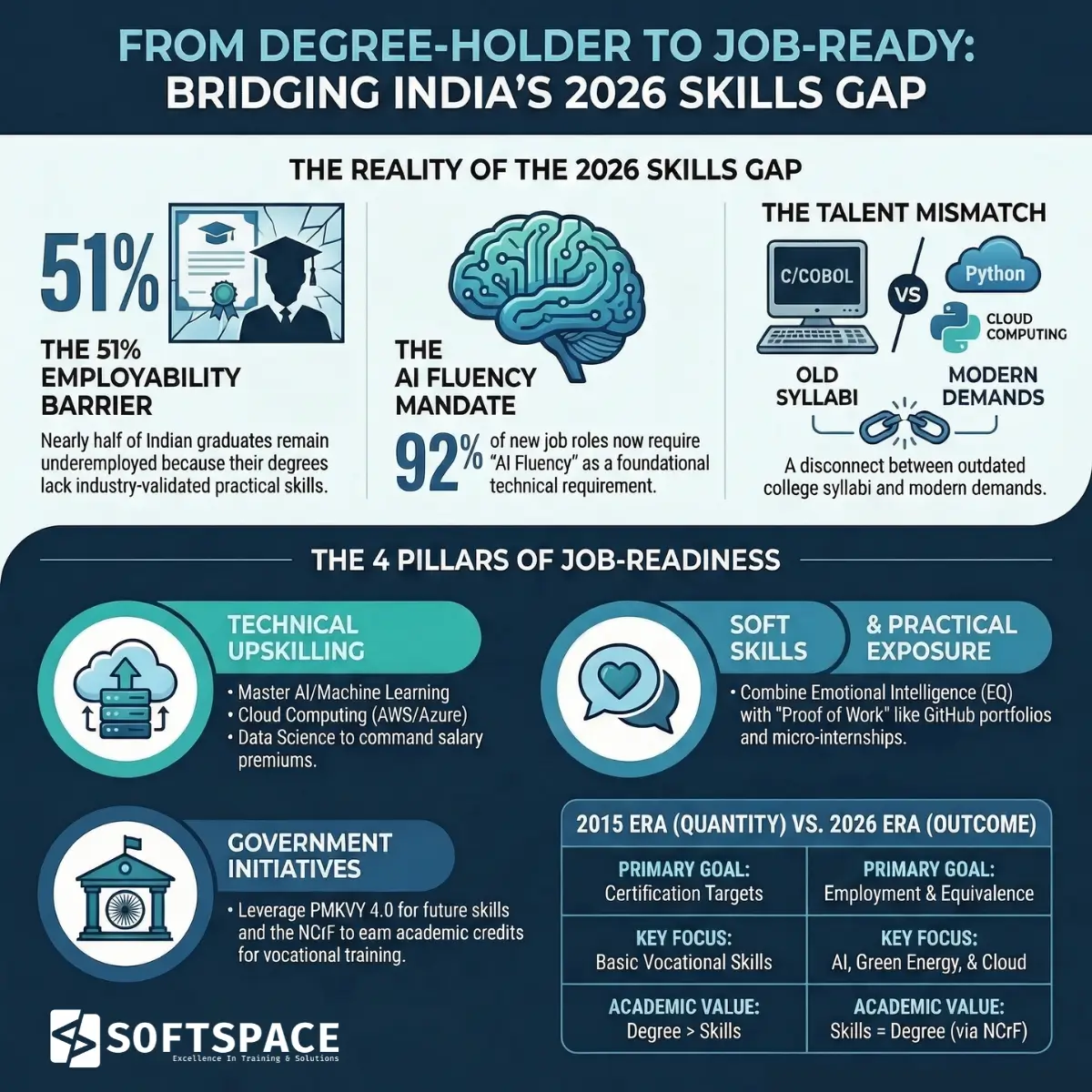
India produces over 1.5 million engineers and millions of other graduates every year. Yet, according to the Economic Survey 2024, only 51% of Indian graduates are considered employable by industry standards. This staggering gap between the sheer volume of degree holders and those who are actually job-ready is one of the most pressing challenges India faces today.
The problem isn’t just about the number of jobs available; it’s about a deep-rooted skill gap between what colleges teach and what employers actually need. Fresh graduates often enter the workforce without the technical expertise, soft skills, or real-world experience that modern companies demand.
Why are Indian graduates struggling to get jobs? Understanding this is the first step. Whether it’s outdated syllabi, poor communication skills, or limited exposure to emerging technologies, the causes are many, and so are the solutions. To explore the broader context, read our article on the importance of skill development in India.
To understand where the real opportunities lie, it also helps to look at the fastest-growing careers in India right now.
Table of Contents
Why are Indian graduates struggling to get jobs in India?
| Theme | Supporting Data Point |
|---|---|
| Graduate Employability Rate | Only 51% of Indian graduates are considered employable (Economic Survey 2024). |
| Engineering Readiness Gap | Over 80% of engineering graduates are unfit for knowledge-economy roles (Aspiring Minds 2023). |
| Soft Skills Deficit | 60% of employers cite lack of communication skills as a primary hiring barrier (TeamLease 2022). |
| Technical Proficiency Gaps | Mismatch in AI, Cloud Computing, and Digital Marketing/SEO skills. |
| Government Interventions | Skill India Mission and PMKVY (300+ job roles). |
Indian graduates struggle to get jobs primarily due to a mismatch between academic education and industry requirements. Outdated curricula, lack of soft skills, insufficient practical exposure, and limited awareness of emerging technologies make a large portion of graduates unemployable despite holding degrees.
The Current Employability Crisis in India
India is in the midst of a silent employability crisis. Millions of graduates pass out of universities every year, yet a large fraction of them remain unemployed or underemployed for months, sometimes years after graduation.
The reasons are structural and systemic. Most Indian universities continue to follow curricula that were designed decades ago, with little to no alignment with the fast-changing demands of modern industries. Graduates often lack the practical exposure, portfolio work, or industry-relevant knowledge that employers look for on day one.
According to a 2023 Aspiring Minds National Employability Report, over 80% of engineering graduates in India are not fit for any knowledge-economy job. The core issues include:
- Syllabi that haven’t been updated to include modern technologies like AI, cloud computing, or data science
- Minimal emphasis on practical projects, labs, or industry collaboration
- A wide mismatch between what employers need and what degree programmes offer
- Poor access to quality education and career guidance, especially in Tier 2 and Tier 3 cities
📌 What percentage of Indian graduates are employable?
According to the Economic Survey 2024, only about 51% of Indian graduates are employable. In the engineering stream specifically, studies suggest fewer than 20% of graduates are ready for knowledge-economy roles without additional training or upskilling.
While IT sector jobs for freshers do exist, the gap between available roles and qualified candidates has never been wider. And with jobs increasingly being replaced by automation, graduates without updated skills face an uphill battle.
💬 From Our Experience at Softspace Solutions
Over the years, we have guided learners through some of the most unconventional career pivots you can imagine and watched every single one of them succeed.
A NEET drop student who spent three years preparing for medicine switched to BBA and IT. Their analytical thinking and discipline, sharpened during those NEET years, made them stand out almost immediately. Today, they work in a health-tech company, bridging clinical knowledge and technology in a way very few professionals can.
An Electronics and Telecommunication (ETC) engineering student quit in their first year to pursue BCA and full-stack development. Within 18 months, they had a portfolio, a GitHub profile employers could actually evaluate, and a job offer at a product company. Today, they build software for a living and have never looked back.
A BCom student walked away from CA mid-journey to enter digital marketing. Their ability to read financial data and think in terms of numbers turned out to be a rare edge in performance marketing. Within 14 months, they were managing full campaigns for a fast-growing e-commerce brand.
None of these journeys were straight line. All of them worked.
The Indian job market does not reward the degree you hold. It rewards the skills you demonstrate. The people who flourish are not always those who choose the right stream from the start. They are the ones who dared to change direction and the discipline to build the right skills once they did.
Insights shared by the Softspace Solutions Career Counselling Team, based on real learner interactions from our community.
Causes of Graduate Unemployment
Graduate unemployment in India is not the result of a single failure; it is caused by a combination of educational, social, and economic factors. Here’s a closer look at the key causes:
Outdated College Curriculum
| Skill Area | Typically Taught in College | What Industry Uses Today? |
| Programming | C, C++, Java (basic) | Python, Rust, TypeScript |
| Database | Basic SQL, DBMS theory | PostgreSQL, MongoDB, BigQuery |
| AI/ML | Rarely covered | TensorFlow, PyTorch, LLM APIs |
| Cloud | Not included | AWS, Azure, Google Cloud |
| Version Control | Rarely practical | Git, GitHub, CI/CD pipelines |
| Data Tools | MS Excel (basic) | Power BI, Tableau, Apache Spark |
A major reason Indian graduates are not job-ready is that their college syllabi are stuck in the past. Most Indian universities, especially state-run and affiliated institutions, follow curricula approved years or even decades ago. The syllabus revision cycle is painfully slow, meaning students graduate with knowledge of technologies that are already obsolete.
For instance, many computer science graduates still study C and COBOL while industries have already moved to Python, machine learning, and cloud infrastructure. A quick look at current trending technologies in the IT industry reveals just how wide this gap has grown.
Lack of Soft Skills
Beyond technical knowledge, Indian employers consistently highlight the lack of soft skills as a key barrier to hiring fresh graduates. Skills such as:
- Effective communication in English and regional languages
- Leadership and teamwork
- Critical thinking and problem-solving
- Adaptability in dynamic work environments
are rarely developed in a typical classroom environment. Understanding “soft skills vs technical skills” is the first step toward building a complete professional profile.
Technical Skills Mismatch
| Technical Skill | Average Starting Salary (INR/year) | Job Openings (approx.) |
| Python / Data Science | ₹5–8 LPA | 1,20,000+ |
| Artificial Intelligence / ML | ₹6–10 LPA | 80,000+ |
| Cloud Computing (AWS/Azure) | ₹5–9 LPA | 95,000+ |
| Digital Marketing | ₹3–5 LPA | 1,50,000+ |
| Cybersecurity | ₹5–8 LPA | 40,000+ |
| Full Stack Development | ₹4–8 LPA | 1,10,000+ |
The technology landscape is evolving at a speed that universities simply cannot match. Today’s employers need graduates who understand:
- Artificial Intelligence (AI) and Machine Learning
- Cloud Computing (AWS, Azure, Google Cloud)
- Data analysis and visualisation tools
- Cybersecurity fundamentals
- Digital marketing and SEO
If you’re unsure which technical skill to prioritise, start by exploring the highest-paying programming languages in India — it gives a data-backed view of where demand and salaries intersect.
The skills required for Artificial Intelligence are a great starting benchmark for graduates in the tech stream, while high-demand skills for the next 10 years cover a broader view across all industries.
Graduates who cannot demonstrate proficiency in even one of these future-relevant skills are at a severe disadvantage in today’s job market.
Regional Disparities
While graduates from Tier 1 cities like Bengaluru, Mumbai, and Delhi have access to better colleges, internship opportunities, and employer networks, the same cannot be said for graduates from Tier 2 and Tier 3 cities.
These graduates face multiple disadvantages: weaker college infrastructure, fewer industry connections, limited internet and digital learning resources, and language barriers. As a result, regional inequality significantly contributes to graduate unemployment in India.
📌 Why are engineering graduates not getting jobs in India?
Engineering graduates in India struggle to find jobs because most are trained in outdated technologies, lack practical project experience, and are unable to demonstrate soft skills like communication and teamwork. Only a fraction of graduates meet the expectations of tech companies, leading to mass unemployment despite having a degree.
The Skills Gap – A Deeper Look
The term “skill gap” refers to the difference between the skills employers need and the skills that job-seekers actually possess. In India, this gap is not just wide, it is widening every year as technology evolves faster than education systems can adapt.
At its core, the disconnect is between academic knowledge and practical application. Students may understand the theory of networking or software development, but have never built a real-world project, worked in a team environment, or used the tools that companies rely on daily.
The Indian government has recognised this challenge and launched several major initiatives to address it:
- Skill India Mission is a flagship initiative to train over 400 million Indians in various skills by 2022, which has now been extended further
- Pradhan Mantri Kaushal Vikas Yojana (PMKVY) is a skill certification scheme offering free short-term training in job-relevant skills
- Private training programmes by companies like NIIT, Simplilearn, Coursera, and upGrad are offering industry-aligned courses
These programmes aim to supplement formal education with the practical and vocational skills that the market demands. This is why the importance of continuous learning cannot be stressed enough; a degree is a starting point, not a finish line.
📌 How can skill development reduce graduate unemployment?
Skill development bridges the gap between academic qualifications and employer expectations. By learning in-demand technical skills, soft skills, and gaining practical exposure through internships or certifications, graduates significantly improve their chances of being hired and becoming productive from day one.
Solutions – How Graduates Can Become Job Ready
The good news is that graduate unemployment, while widespread, is not insurmountable. There are concrete, actionable steps that students and graduates can take to improve their employability even before landing their first job.
Upskilling with Technical Courses
One of the most effective ways to become job-ready is to invest in technical upskilling outside of one’s college coursework. The most in-demand technical skills today include:
- Artificial Intelligence and Machine Learning — essential across sectors from healthcare to finance
- Data Analysis and Business Intelligence — Python, SQL, Power BI, Tableau
- Cloud Computing — certifications in AWS, Azure, or Google Cloud are highly valued
- Digital Marketing — SEO, paid ads, social media strategy, and analytics
Platforms like Coursera, upGrad, and NPTEL offer free and paid courses that can be completed alongside or after college. Explore more in our future skills for Indian graduates resources.
Soft Skills Training
Soft skills are the invisible currency of the modern workplace. Graduates who invest in building these skills gain a significant edge in interviews and early career performance:
- Communication — Clear writing, speaking, and listening are critical in virtually every role
- Leadership — Even at entry level, companies look for initiative and the ability to lead small tasks
- Problem-solving — The ability to analyse a situation and propose solutions is universally valued
- Adaptability — Willingness to learn and pivot is especially important in fast-changing industries
Internships & Practical Exposure
Nothing replaces real-world experience. Graduates who have done internships, built personal projects, contributed to open-source, or freelanced are consistently preferred over those with degrees alone.
Practical pathways to consider:
- Apply for internships via platforms like LinkedIn or Naukri
- Build portfolio projects that solve real problems, even personal or non-profit projects count
- Volunteer with NGOs or startups where you can contribute meaningful work
- Take on freelance gigs to build client experience and income simultaneously
Government Programs
The Indian government has launched several programmes to make skill development accessible to all:
- Pradhan Mantri Kaushal Vikas Yojana (PMKVY) — Free short-term skill certification courses in 300+ job roles
- Skill India Mission — Umbrella programme covering multiple skilling initiatives
- SWAYAM — Free online courses from top Indian universities and institutions
- NPTEL — Technical and professional certification courses from IITs and IISc
📌 What skills should Indian graduates learn to get jobs?
Indian graduates should focus on learning technical skills like AI, data analysis, cloud computing, and digital marketing, alongside soft skills like communication, problem-solving, and adaptability. Practical exposure through internships, combined with government-sponsored courses like PMKVY, can significantly boost employability.
Employer Perspective
To understand why Indian graduates are struggling to find jobs, it helps to listen to those doing the hiring. HR managers and hiring leads across sectors have repeatedly pointed to the same pain points when interviewing fresh graduates.
A 2022 TeamLease Employability Report found that:
- Over 60% of employers said fresh graduates lacked the communication skills needed for client-facing roles
- More than 55% said graduates could not demonstrate applied knowledge in their own domain during technical interviews
- Nearly 40% of hiring managers rated “lack of initiative and ownership” as a top disqualifier
| Rejection Reason | % of Employers Citing This |
| Poor communication skills | 63% |
| Lack of technical/domain knowledge | 57% |
| No practical project experience | 52% |
| Low problem-solving ability | 48% |
| Unrealistic salary expectations | 38% |
| Lack of initiative/ownership | 40% |
| Poor attitude/cultural fit | 35% |
Real-world examples from HR circles include:
- Engineering graduates who cannot write or explain a basic algorithm that they claim to know
- MBA graduates who struggle with basic Excel and data interpretation tasks
- Candidates who fail in group discussions due to poor listening and communication skills
The common thread is not a lack of intelligence; it’s a lack of preparation and practical orientation. Companies are not always looking for the highest CGPA; they are looking for candidates who can do the job from day one.
📌 What skills do companies look for in fresh graduates?
Companies look for a combination of technical skills relevant to the role (coding, data tools, domain knowledge), soft skills (communication, teamwork, adaptability), and demonstrated practical experience (internships, projects, portfolios). Cultural fit and willingness to learn are also highly valued by Indian employers.
Conclusion & Actionable Takeaways
The graduate unemployment crisis in India is real, deeply rooted, and growing. But it is also solvable, both at the individual and the systemic level.
Here’s a quick summary of what we’ve covered:
- The problem: Over 49% of Indian graduates are not considered employable by industry standards
- The causes: Outdated curricula, lack of soft skills, technical mismatch, and regional inequality
- The solutions: Upskilling, soft skills development, internships, and government programmes like Skill India and PMKVY
If you are a graduate in India today, the most important investment you can make is in yourself. Take a certification course. Do an internship. Practise your communication. Build something. Every step you take towards becoming more skilled and industry-ready is a step away from unemployment.

Content Strategist | AI Tools Practitioner | Career & Study Abroad Consultant
Sagar Hedau is a content strategist and AI tools practitioner based in Nagpur, India. With 13+ years of experience in career counselling and psychometry, he now works at the intersection of content strategy and no-code AI technology, using tools like Claude, Lovable, LovArt, and Notion AI in his daily workflow. He writes to make AI genuinely accessible for non-technical professionals, students, and business owners who want to build and automate without coding. He also runs an active career counselling practice, helping individuals navigate career decisions with data-backed psychometric analysis.
🌐 sagarhedau.com | 💼 LinkedIn