
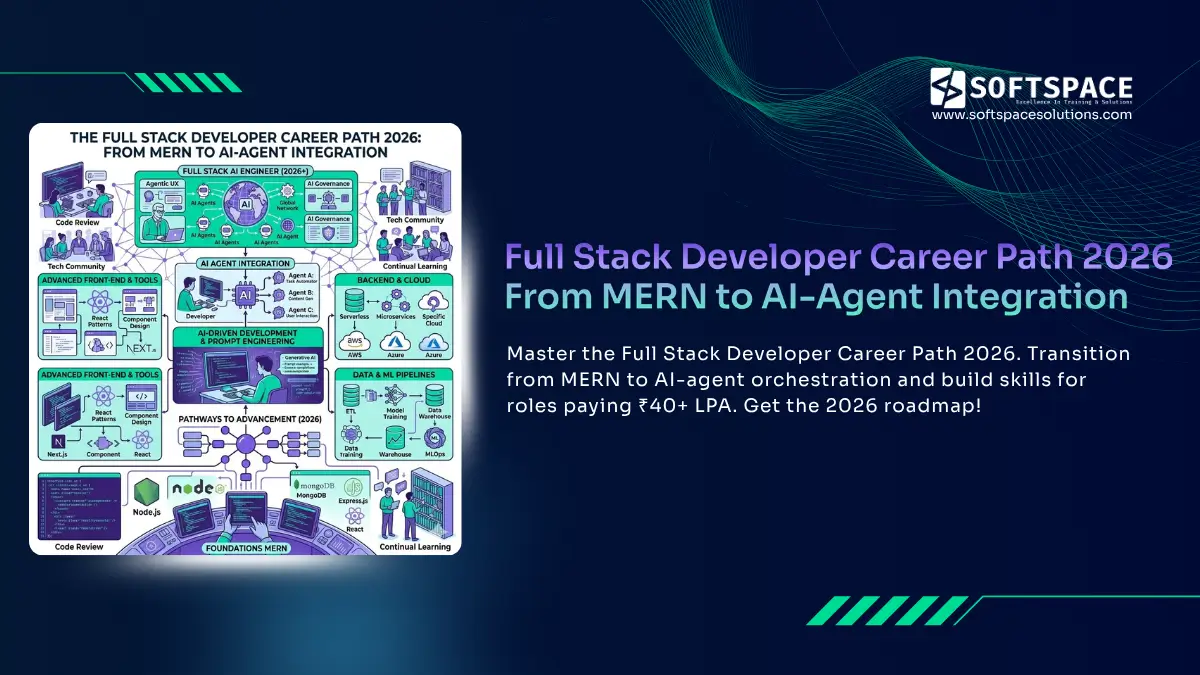
The full stack developer career path in 2026 has shifted from simple feature implementation to orchestrating systems where AI agents, APIs, and humans collaborate. Generic MERN tutorials are no longer enough; success now requires transitioning from a “code implementer” to an “outcome orchestrator”.
This roadmap provides a complete 2026 guide, covering web fundamentals, AI-agent frameworks, and salary benchmarks specific to the Indian market. Whether you are a fresher or a mid-level developer, this path focuses on the high-value skills AI cannot replicate: system design, ethical governance, and complex architectural judgment
Phase 0 and 1: The Foundation Layer — Mindset and Web Fundamentals
Getting the Mindset Right Before Writing a Single Line
Most beginners fall into what is commonly called the “tutorial trap.” They watch video after video, follow along, build the same project the instructor builds, and then stare at a blank screen when asked to build something from scratch. The trap is comfortable because it feels like progress. It is not.
The right approach is to treat AI tools like ChatGPT, GitHub Copilot, or Claude as collaborators, not crutches. Use them to understand code you have written, to get unstuck faster, and to generate boilerplate. Do not let them replace the process of actually thinking through a problem.
“Learning to code with AI is like learning to cook with a recipe app. Useful. But if you never learn why the ingredients work together, you cannot adapt when something goes wrong.”
The importance of skill development in India has never been more critical, especially as AI raises the floor for what counts as a “basic” skill.
Tools to Master First
Before you touch a framework, these three tools should feel natural:
- VS Code with essential extensions (ESLint, Prettier, GitLens, GitHub Copilot)
- Git for version control — commits, branching, pull requests, and merge conflicts
- CLI basics — navigating directories, running scripts, working with npm/yarn
Skipping this layer is one of the primary reasons Indian graduates struggle to get jobs. Employers expect these tools to be second nature, not something you learn on the job.
Web Foundations You Cannot Skip
HTML, CSS, and JavaScript form the bedrock. In 2026, “knowing HTML” means understanding semantic markup for accessibility and SEO. “Knowing CSS” means being comfortable with the Box Model, Flexbox, and Grid without reaching for Stack Overflow every five minutes.
For JavaScript and TypeScript, the non-negotiables are:
- ES6+ syntax: destructuring, spread/rest, template literals, modules
- Asynchronous patterns: Promises, async/await, error handling
- TypeScript fundamentals: types, interfaces, generics, strict mode
“TypeScript is no longer optional for serious projects. It is the baseline expectation in most product companies by 2026.”
If you are looking for structured learning, check out the best free web development courses to get started without breaking the bank.
Phase 2 and 3: Mastering the Application Layer — The MERN Baseline
Frontend Evolution: React and Next.js in 2026
React remains the dominant choice for frontend development in 2026. If you are building on React, you need to understand server components versus client components, which became central to how Next.js applications are structured since the App Router was introduced. This is not just a syntactic difference — it fundamentally changes how data flows through your application and how you think about performance.
For state management, the landscape has simplified. Zustand has become the go-to for most mid-scale applications due to its minimal boilerplate. Redux Toolkit still has a place in large enterprise applications with complex shared state. The advice is to learn Zustand first and understand Redux enough to work in existing codebases.
Backend Responsibilities: Node.js, Express, and Beyond
Node.js remains the go-to backend runtime for full stack developers working in the JavaScript ecosystem. The areas that separate mediocre backend developers from strong ones are not framework knowledge — they are the fundamentals underneath:
- Authentication: JWT, OAuth 2.0, session management, token refresh strategies
- Middleware: Request validation, rate limiting, logging, error handling pipelines
- Input Validation: Using libraries like Zod or Joi to prevent injection and bad data
- API Design: RESTful conventions, versioning, pagination, and increasingly — GraphQL
Data Management: SQL, NoSQL, and the Emergence of Vector Databases
The classic debate of SQL versus NoSQL has a cleaner answer now. Use PostgreSQL as your default relational database. It is battle-tested, handles JSON natively, and in 2026, supports pgvector — which means your relational database can also serve as a vector store for AI embeddings. That is significant.
MongoDB still has strong use cases for unstructured, document-heavy data. If you are building content platforms, logging systems, or applications where schema flexibility is a real requirement, MongoDB makes sense.
The new addition to every serious full stack developer’s toolkit is pgvector. As you build features powered by semantic search or retrieval-augmented generation, having vector similarity search sitting alongside your relational data removes an entire layer of infrastructure complexity.
Phase 4: The AI Pivot — Building AI-Agent Systems
This is where the 2026 full-stack developer career path diverges sharply from what was taught just two years ago. Understanding how to build with LLMs is no longer a specialisation. It is becoming a baseline expectation for any developer working on modern products.
LLM Fundamentals Every Developer Needs
You do not need to train models to use them effectively. What you do need to understand:
- Prompt engineering: How to structure inputs to get consistent, accurate outputs. Chain-of-thought prompting, few-shot examples, and system instruction design.
- Structured output: Forcing LLMs to return JSON, using function calling, and validating responses with Zod schemas.
- Temperature and sampling: How temperature affects creativity versus consistency. When to use deterministic settings for data extraction tasks.
- Token management: Understanding context windows, chunking strategies, and cost implications of long prompts.
If you are looking to build a formal foundation, the best free generative AI courses provide solid starting points for these concepts.
AI Agent Frameworks: LangGraph vs CrewAI vs LlamaIndex
Choosing the right framework depends heavily on what you are building. Here is a practical breakdown:
- LangGraph: Best for controllable, stateful orchestration. If you need to define explicit decision trees, retry logic, and human-in-the-loop checkpoints, LangGraph gives you the graph-based control flow to do that. The learning curve is steeper, but the control is worth it for production systems.
- CrewAI: Built for rapid multi-agent prototyping. If you need to spin up a team of specialised agents quickly — a researcher, a writer, a fact-checker — CrewAI handles the role assignment and inter-agent communication with minimal configuration. Great for demos and MVPs.
- LlamaIndex: Purpose-built for data-centric agents. If your primary use case involves retrieving, indexing, and querying over large document sets, LlamaIndex has the most mature tooling for that workflow, including native RAG pipelines and document parsers.
“No single framework wins in every scenario. Senior developers are expected to know when to use each one, not to pick a favourite and force it into every problem.”
Agent Memory Systems: RAG, Vector Stores, and Graph Memory
A stateless LLM has no memory of previous interactions. Making agents useful across multi-turn conversations and complex tasks requires intentional memory architecture.
- RAG (Retrieval-Augmented Generation): The baseline approach. Chunk documents, embed them, store them in a vector database, and retrieve relevant context before each LLM call. Works well for knowledge-base queries and document Q&A.
- Vector Stores: Pinecone, Weaviate, Chroma, and pgvector each have trade-offs. For most full-stack applications, pgvector’s integration with PostgreSQL is the path of least resistance. For high-throughput, large-scale retrieval, dedicated vector databases have an edge.
- Graph-based Memory: For agents that need multi-hop reasoning — “What is the relationship between this customer’s past orders and their current support ticket?” — graph databases like Neo4j, combined with LLM reasoning layers, enable connections that flat vector search cannot surface.
The AI and machine learning courses guide is a good reference for learning these concepts through structured coursework rather than scattered documentation.
The “Agent-First” Development Paradigm
AI-Native IDEs and the Shift to Agent-Centric Workflows
Cursor 2.0 and similar AI-native IDEs represent a genuine shift in how code gets written. The older model was file-centric: you opened a file, edited it, and saved it. The new model is agent-centric: you describe an outcome, and the IDE’s embedded agent reasons across your codebase, makes edits, runs tests, and iterates.
The practical implication for developers is that knowing how to prompt your IDE effectively is now a real skill. Writing vague instructions produces vague results. Writing precise, context-rich instructions — specifying constraints, expected behaviour, and edge cases — produces code that actually works.
For a curated list of tools in this space, the AI tools for coding guide covers the most relevant options in the current landscape.
Vibe Coding: What It Is and What It Is Not
“Vibe coding” refers to the practice of describing software behaviour in natural language and letting AI generate the implementation. The term, popularised in early 2025, captures something real: AI coding tools have become capable enough that a developer can prototype an entire feature by describing it conversationally. You can read more about it in the what is Vibe Coding guide.
The productivity gains are real. The risks are also real. Code generated through vibe coding often lacks proper error handling, ignores edge cases, and can introduce security vulnerabilities that a developer who understands the implementation would have caught. Vibe coding is a legitimate acceleration tool in the hands of a developer who can review and reason about the output. It is a liability in the hands of someone who cannot.
“The developer who uses vibe coding wisely is someone who would have been able to write that code themselves. They are using AI to go faster, not to avoid understanding.”
Multi-Agent Parallelism
One of the more powerful patterns in advanced agent systems is running multiple agents in parallel with different configurations or model choices, then synthesising or comparing their outputs. Use cases include:
- Running a conservative and a creative agent on the same problem and letting a judge agent evaluate both
- Splitting a large research task across domain-specific agents simultaneously
- Model comparison pipelines that test GPT-4o versus Claude versus Gemini on the same prompt for quality benchmarking
Phase 5: Deployment, AI Governance, and Security
Production Quality: Docker and CI/CD
Containerisation with Docker is non-negotiable for any developer shipping to production in 2026. Understanding how to write lean Dockerfiles, manage multi-stage builds, and orchestrate containers with Docker Compose is the minimum. Kubernetes knowledge is a significant advantage for roles at larger companies.
For CI/CD, GitHub Actions has become the default for most teams. A well-structured pipeline should include: linting, type checking, unit tests, integration tests, build, and deployment to staging before production. If you want to understand the infrastructure side more deeply, the how to become a Cloud DevOps engineer guide covers the adjacent DevOps career path.
AI Governance Framework: A Practical Implementation Guide
Shipping an AI feature without governance controls is the 2026 equivalent of shipping without input validation. You are not thinking about what happens when things go wrong. Real-world AI governance for full-stack developers includes:
- PII Filtering: Detecting and masking personally identifiable information before it reaches an LLM or gets stored in logs.
- Toxicity Detection: Using classification models or API-based guardrails to catch harmful outputs before they reach users.
- Human-in-the-Loop (HITL): For high-stakes decisions — financial transactions, medical recommendations, legal content — building approval workflows where a human reviews the agent’s proposed action before it executes.
- Audit Trails: Logging agent actions, model inputs/outputs, and decision points for debugging and compliance.
Security for 2026: Threats Specific to AI Systems
Traditional web security knowledge remains essential. OWASP Top 10, SQL injection prevention, and CSRF protection — these are table stakes. Agentic systems introduce new threat vectors:
- Prompt Injection: Malicious users embedding instructions in user inputs designed to override system prompts or manipulate agent behaviour. Mitigation involves input sanitisation, structured prompt templates, and output validation.
- Hallucination Risk: LLMs confidently generating false information. In applications where accuracy is critical, RAG with verified sources and output validation against known schemas reduces this risk.
- SOC 2 and GDPR Compliance: If your application processes user data through an LLM, you need to understand data residency requirements, third-party data processing agreements, and the implications of sending PII to external model APIs.
EEAT Section: The Reality of AI, Coding Jobs, and How to Navigate the Disruption
This section addresses something most roadmap articles avoid: the genuine disruption happening in the developer job market due to AI. We believe you deserve a clear-eyed view of what is changing, not a reassuring but vague statement about how “AI will create new jobs.”
What Is Actually Happening to Coding Jobs
The entry-level is being compressed. Tasks that previously required a junior developer — writing boilerplate, building CRUD interfaces, writing basic test cases — are now being handled by AI tools in a fraction of the time. This does not mean junior developer jobs are disappearing overnight, but it does mean the bar for entry has risen significantly. A junior developer in 2026 needs to demonstrate competence that would have been associated with a mid-level developer two years ago.
The impact of AI on employment is real and documented. Routine coding, simple integrations, and repetitive maintenance tasks are the most exposed. The roles that remain resilient are those requiring system-level thinking, architectural judgment, stakeholder communication, and the ability to evaluate and govern AI outputs.
This is backed by what is being reported across Indian IT companies. Several large service firms have reduced fresher intake, not because work has disappeared, but because the same output can be achieved with fewer, more senior developers using AI tools.
If you are wondering whether the AI job market is oversaturated, the honest answer is: saturated at the commodity level, genuinely scarce at the orchestration and architecture level.
How to Navigate the Disruption
The developers who are thriving are not the ones who avoided AI. They are the ones who integrated it earliest and pushed the most aggressive version of the collaboration. Specific strategies that work:
- Build in public: Portfolio projects with live AI features demonstrate practical skills more effectively than certifications. A deployed AI-powered application tells a hiring manager something a resume line cannot.
- Specialise upward: Move from generalist full-stack work toward a specific, higher-value intersection — AI engineering, system architecture, or DevSecOps for AI systems.
- Develop the skills AI cannot replicate: System design, ethical reasoning about AI deployment, client communication, and the ability to translate business problems into technical architectures. These are not being automated.
- Stay current with governance: Developers who understand AI risk — prompt injection, hallucinations, compliance requirements — are valuable in ways that purely technical skills alone cannot create.
For those considering a broader career pivot, the AI career survival guide for India 2026 addresses the career strategy side of this transition in detail.
“The question is no longer ‘”will AI affect my job?” It already has. The question is whether you are going to be the person directing AI or the person being replaced by someone who is.”
Career Path and Salary Outlook in 2026
Experience Tiers and Salary Benchmarks (India)
Here is an honest look at where compensation sits across experience levels in the Indian market, incorporating the AI skill premium:
- Junior Full Stack Developer (0 to 1 year): ₹4 to ₹8 LPA. At service companies and startups. The lower end represents roles with limited AI exposure. The upper end increasingly requires demonstrable AI tool proficiency.
- Mid-level Full Stack Developer (2 to 4 years): ₹10 to ₹20 LPA. With MERN expertise and some AI integration experience. Product companies and funded startups are paying significantly above this range for candidates with agent development experience.
- Senior Full Stack / AI-Integrated Developer (4 to 6 years): ₹22 to ₹35 LPA. Candidates who can architect AI-augmented systems, manage deployment pipelines, and lead small teams.
- AI-Powered Full Stack Lead (6+ years): ₹40+ LPA. Includes system architects, principal engineers, and technical leads at growth-stage companies where AI is core to the product.
For a broader salary landscape across roles, the AI engineer salary trends 2026 and the highest paying IT jobs in India provide useful context.
Career Specialisation Paths
The “generalist full stack developer” role is becoming a launchpad rather than a destination. The natural evolution paths are:
- AI Engineer: Focuses on model integration, agent design, prompt engineering, and LLM infrastructure. The fastest-growing and highest-paid specialisation in the current market.
- System Architect: Designs large-scale distributed systems, makes technology stack decisions, and owns the technical vision for a product. Requires broad experience across the stack.
- DevSecOps for AI: A new specialisation combining CI/CD expertise, security, and AI governance. Highly valued as organisations try to ship AI features without creating compliance nightmares.
For context on the fastest-growing roles, the highest paying engineering jobs guide covers compensation across multiple engineering disciplines.
Certification and Learning Strategy for 2026
Top Certifications Worth Pursuing
Certifications alone do not get you hired, but the right ones signal that you have invested time in structured learning and understand current tooling. The most relevant for this career path:
- AWS Certified AI Practitioner: Validates understanding of AWS AI/ML services, including Bedrock, SageMaker, and Rekognition. Strong signal for developer roles at companies running on AWS infrastructure.
- Google AI Essentials: Google’s foundational AI certification covering practical applications. Less technical than AWS, but useful as a baseline credential for those early in the AI learning curve.
- IBM Generative AI Engineering Professional Certificate (Coursera): Covers prompt engineering, RAG systems, and LLM application development. One of the more technically substantive certifications in the generative AI space.
- Meta’s React Certification: Remains relevant as a signal of frontend fundamentals proficiency.
For a broader list of IT certifications worth pursuing, the best certifications for IT beginners cover both foundational and advanced options.
Building a Portfolio That Actually Gets Attention
Certifications support your portfolio. The portfolio is the actual signal. Projects that get noticed in 2026 are not to-do apps or basic CRUD interfaces. They are projects that demonstrate:
- A live AI feature that a user can interact with (not just a demo video)
- A clear problem being solved with RAG or agent orchestration
- Proper deployment — not just code on GitHub, but a running application with a real URL
- Documentation that explains architectural decisions, not just what the project does
“One solid project that works in production is worth more than ten tutorial-style repositories.”
Conclusion: Staying Human in an AI-Driven Path
There is a version of this roadmap that sounds like a checklist: learn React, add LangGraph, deploy on AWS, get certified. That version misses the point.
The developers who are building careers that will matter in 2026 and beyond are the ones investing in capabilities that AI does not have. System design requires judgment about trade-offs that are not always technical. Ethical decision-making around AI deployment — deciding what an agent should and should not be allowed to do — requires values, not just code. Client communication, team leadership, and the ability to translate between what a business needs and what technology can deliver are deeply human skills.
AI will continue to get better at generating code. The humans who direct it, evaluate it, and take responsibility for what it builds will remain essential.
For those further along, the highest paying AI jobs resource maps out where the best-compensated roles are concentrated.
“The roadmap is not a fixed path. It is a set of principles for building skills that compound. Start with fundamentals, add AI collaboration early, and never stop shipping real things.”
Frequently Asked Questions
What is the full stack developer career path in 2026?
A full stack developer career path in 2026 starts with web fundamentals (HTML, CSS, JavaScript, TypeScript), progresses through frontend frameworks (React, Next.js) and backend development (Node.js, Express, PostgreSQL, MongoDB), and increasingly requires proficiency in AI integration — including LLM APIs, agent frameworks like LangGraph or CrewAI, and vector databases. The career path then branches into specialisations such as AI Engineering, System Architecture, or DevSecOps, depending on individual strengths and market demand.
Is MERN stack still relevant in 2026?
Yes. The MERN stack (MongoDB, Express, React, Node.js) remains highly relevant as a foundational skill set. What has changed is that MERN alone is no longer sufficient for senior roles. Developers are expected to layer AI integration skills on top of the MERN baseline. PostgreSQL has also gained significant ground over MongoDB for many use cases, particularly with pgvector enabling vector search natively.
How does AI affect the entry-level developer job market in India?
AI tools are compressing the entry level by automating many tasks that previously required junior developers — boilerplate generation, basic CRUD implementation, simple test writing. This means freshers need to enter the market with a higher baseline of practical skill than was expected two or three years ago. The skill gap in India is widening between graduates who have built real projects and those who have only completed coursework.
What is the salary for an AI-powered full stack developer in India?
Compensation varies by experience and skill depth. Junior roles with basic AI tool exposure start at ₹4 to ₹8 LPA. Mid-level developers with genuine MERN plus AI integration skills earn ₹10 to ₹20 LPA. Senior developers capable of designing and deploying AI-agent systems command ₹22 to ₹35 LPA. Technical leads at product companies focusing on AI-core products are reaching ₹40+ LPA. See the AI engineer salary trends 2026 for detailed breakdowns.
Q5. What are the best AI agent frameworks for full stack developers?
The three most relevant frameworks in 2026 are LangGraph (best for controllable, stateful, production-ready agent systems), CrewAI (best for rapid multi-agent prototyping and role-based agent teams), and LlamaIndex (best for data-intensive retrieval and document-centric agents). The right choice depends on your use case, not a universal ranking. Most senior developers are familiar with all three.
What is vibe coding, and should I use it?
Vibe coding refers to programming by describing intent in natural language and letting AI generate the implementation. It accelerates prototyping significantly. However, it is only safe and productive in the hands of a developer who can review, understand, and correct the generated code. Using vibe coding without the underlying knowledge to evaluate the output creates security risks and brittle systems. Learn more at the what is vibe coding guide.
Can I switch to a full stack AI developer role after 30?
Absolutely. Career transitions into AI-integrated development are happening at all ages. The key factors are demonstrated skills through real projects, not educational credentials or age. The article, is it too late to switch to an AI career after 30 in India addresses this question directly with practical guidance for career changers.

Content Strategist | AI Tools Practitioner | Career & Study Abroad Consultant
Sagar Hedau is a content strategist and AI tools practitioner based in Nagpur, India. With 13+ years of experience in career counselling and psychometry, he now works at the intersection of content strategy and no-code AI technology, using tools like Claude, Lovable, LovArt, and Notion AI in his daily workflow. He writes to make AI genuinely accessible for non-technical professionals, students, and business owners who want to build and automate without coding. He also runs an active career counselling practice, helping individuals navigate career decisions with data-backed psychometric analysis.
🌐 sagarhedau.com | 💼 LinkedIn