
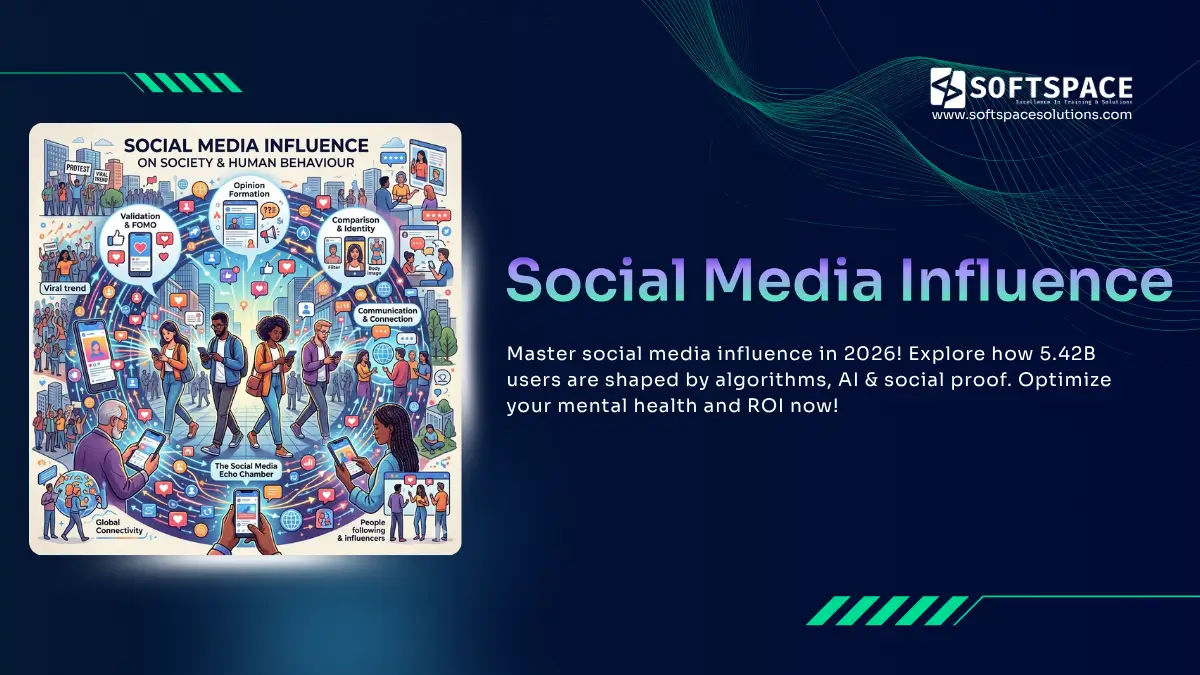
Social media influence is no longer a buzzword. It is one of the most powerful forces shaping how people think, buy, vote, and feel about themselves.
In 2026, more than 5.42 billion people use social media every day. That is 64% of the entire global population. The average person uses nearly seven platforms a month and spends over two hours a day scrolling.
Whether you are a brand, a student, a job seeker, or a parent, understanding how social media influence works is essential. This guide breaks it all down.
Table of Contents
What Is Social Media Influence?
Social media influence is the ability of platforms, content, and people on social media to shape opinions, decisions, and behaviour.
It works through three main channels.
- People: Friends, influencers, and public figures whose posts shape how we think about topics, products, or causes.
- Algorithms: Every platform uses ranking systems that decide what you see first. They quietly push certain ideas and bury others.
- Social proof: When thousands of people like or share something, we are wired to take it more seriously.
Social Media Influence in 2026: The Numbers That Matter
Before diving deeper, here are the stats that define the scale of social media influence this year.
- 5.42 billion active social media users globally, roughly 64% of the world’s population
- 2h 21m average time spent per day on social media worldwide
- 90% of consumers use social media to stay up to date with trends and current events
- 81% of marketers say increased exposure is the top benefit of social media marketing
- $5.20 average return for every $1 spent on influencer marketing
- 73% of businesses using AI for social content report higher engagement
These numbers are not just impressive. They show how deeply social media has become part of everyday decisions.
How Social Media Influences People
Knowing the mechanics behind social media influence helps you understand why it is so effective and, sometimes, so hard to resist.
Social Proof
- A post with 50,000 likes gets attention because the brain reads high engagement as a signal of credibility.
- Platforms have built this dynamic into every feature, from like counts to trending hashtags to live viewer numbers.
The Algorithm Effect
- No two people see the same feed. Algorithms study your behaviour and build a personalised stream designed to keep you engaged.
- This means social media influence does not only come from the people you follow. It also comes from the machine deciding what to show you next.
Trust and Parasocial Relationships
When someone follows a creator for months or years, they begin to feel like they know them.
This one-sided connection, called a parasocial relationship, is a big reason why influencer recommendations feel more genuine than ads. That trust translates directly into action.
The Speed of Information
A video posted Monday morning can reach 50 million people before Tuesday. That speed amplifies the influence of any message, accurate or not.
Social Media Influencers: Who They Are and Why They Work
Influencers are people with engaged followings who shape their audience’s opinions and decisions.
In 2026, smart brands are moving beyond chasing celebrities. Niche creators with smaller but more loyal audiences often deliver better results.
There are four main tiers.
- Nano-influencers (1K to 10K followers): Very high engagement. Audiences feel a personal connection.
- Micro-influencers (10K to 100K): The sweet spot for many brands. Authentic but with real reach.
- Macro-influencers (100K to 1M): Good for product launches and awareness campaigns.
- Mega-influencers and celebrities (1M+): Maximum reach, but lower trust scores.
22% of active social media users follow influencers or experts. With AI-generated content flooding feeds in 2026, genuine voices have become even more valuable.
The Positive Influence of Social Media
Access to Information and Education
Organisations like the WHO, universities, and health services use social media to reach billions of people in real time.
Teachers and experts share knowledge freely. Platforms like YouTube and LinkedIn have become major tools for skill development and professional growth — particularly in countries where formal learning resources are limited.
Community and Connection
For people who feel isolated, whether because of geography, disability, or social anxiety, social media provides a real connection.
Communities form around shared passions, identities, and causes. These networks offer support and belonging that people might struggle to find offline.
Social Activism
Social media influence has driven real-world change. Movements for civil rights, environmental action, and gender equality grew from hashtags into global mobilisations.
When users share content about causes they care about, they shift public attention and pressure decision-makers.
Business and Economic Opportunity
For small businesses, social media has levelled the playing field. A well-crafted post can outperform a television ad. It also opens doors to digital marketing careers for individuals who know how to use these platforms strategically.
The Negative Influence of Social Media
Mental Health and Self-Esteem
- Over 50% of teenagers report feeling anxious or depressed after spending time on social media.
- 40% of adults say it makes them feel lonely or isolated. This is the paradox of connection.
- The core problem is comparison. Feeds are filled with curated highlights. You end up comparing your unfiltered life to everyone else’s edited reel.
- 60% of social media users say it negatively affects their self-esteem
- 2.7x increased risk of depression in adolescents who spend more than 3 hours daily on social media
Addiction and Sleep Disruption
- 1 in 4 people describe themselves as feeling addicted to social media.
- 78% of users scroll before going to sleep. Heavy users sleep an average of one hour less per night. That sleep debt adds up fast.
Cyberbullying
- Around 60% of teenagers have experienced cyberbullying on social media. That figure has barely moved despite years of platform moderation efforts.
- 70% increase in depression rates among teens who experience cyberbullying
- 40% rise in online harassment cases since 2020
Unlike traditional bullying, social media harassment follows someone home. The public nature of these platforms means humiliation can happen in front of thousands.
Misinformation
Emotionally charged, outrage-inducing content spreads faster than calm, accurate information. Platforms reward engagement, not truth.
This creates conditions where false information can go viral before it has been corrected. The impact touches public health, politics, and everyday trust.
Social Media Influence on Politics
Political campaigns in 2026 are shaped by social media more than any other channel.
Young voters are more likely to encounter political content through feeds and short-form video than through traditional news. That makes platforms central to how democracy functions.
On the positive side, social media gives ordinary citizens a voice and a way to hold public figures accountable.
On the negative side, it creates fertile ground for disinformation, polarisation, and manipulation. The line between authentic political expression and coordinated influence campaigns can be very hard to see.
Social Media Influence on Work Culture and Hiring
About 19% of hiring managers factor in a candidate’s social media presence when making decisions.
This makes personal branding a real professional concern. LinkedIn, in particular, has become a tool for career visibility. How you present yourself online can open or close doors.
Social media has also changed how people learn at work. Creators and trainers now teach through live sessions and short-form video. The impact of AI on digital marketing has accelerated this shift, with AI tools now helping professionals create content, analyse data, and grow their audiences faster than ever.
Social Media Influence on Consumer Behaviour
Before social media, a recommendation came from a friend, a magazine, or an ad. Today it comes from a comment section, a review on Instagram, or an unboxing video.
Nearly half of consumers say they now interact with brands more often on social media than they did six months ago.
Poor reviews drive customers away. Strong engagement builds loyalty. And with social commerce built into most major platforms, the journey from discovery to purchase can now happen entirely within a single app.
Understanding how digital marketing influences consumer behaviour is one of the most valuable skills for any brand or marketer operating in 2026.
Social Media Influence and Privacy Risks
Every scroll, like, and search feeds the algorithms that shape what you see next. That data also flows to advertisers and third parties.
Many users have a limited understanding of how public versus private settings actually work. Content shared publicly can be screenshot and reshared within seconds, long before anyone realises a mistake was made.
Identity theft, online stalking, and misuse of personal information remain real and growing risks. Once something is online, removing it is far harder than posting it.
AI and the Future of Social Media Influence in 2026
Artificial intelligence is reshaping social media influence at every level.
For creators and brands, AI tools now help with writing posts, generating images, analysing audience data, and personalising communication at scale.
For platforms, AI drives the recommendation engines that decide what surfaces and what gets buried. These systems are becoming more personalised and harder to understand from the outside.
For users, AI-generated content is already everywhere. Deepfakes, synthetic influencers, and AI-written posts sit alongside genuine human content. Telling them apart is increasingly difficult.
If you want to understand where this is heading, read more about the applications of AI in social media and how brands and creators are using it right now.
How to Use Social Media Influence Wisely
Social media influence is not something that just happens to you. You have real choices about how you engage with it.
For Individuals
- Be aware of the algorithm. Your feed is curated to keep you engaged, not necessarily to inform you well.
- Follow accounts that leave you feeling informed and energised, not reactive or anxious.
- Set limits on daily use, especially in the hour before sleep.
- Take social comparison cues with serious scepticism. What you see online is rarely the full picture.
- Think before resharing. Passing on unverified content, even with good intentions, contributes to misinformation.
For Brands and Marketers
- Partner with creators whose values align with your brand. Audiences spot inauthenticity quickly.
- Respond to comments and queries publicly and promptly. Responsiveness builds trust faster than any ad.
- Listen to what your audience actually wants to talk about, not just what you want to say.
- Be transparent about paid content. Trust, once lost, is very hard to rebuild.
- Consider micro and nano-influencers. High engagement in a niche community often beats celebrity reach on conversion metrics.
For Educators and Policy Makers
- Media literacy education needs to cover how algorithms work and how to evaluate sources critically.
- Platforms need transparent, enforced standards for paid content and AI-generated posts.
- The mental health impact of social media on young people deserves serious policy attention and funding.
Conclusion: Social Media Influence Is What You Make It
Social media influence in 2026 is a fact of modern life. Over five billion people are on these platforms every day.
The influence is neither good nor bad by itself. It reflects the choices made by the people who use it, the companies that build it, and the regulators who set the rules.
Communities that use social media to share knowledge, build support networks, and advocate for change show what these tools can do at their best.
At the same time, the evidence on mental health, misinformation, and cyberbullying is too significant to ignore.
The question is not whether social media influences you. It does. The real question is whether you are choosing how to be influenced, or simply letting it happen by default.
FAQs
How does social media influence people’s behaviour?
Social media influences behaviour through three main mechanisms: social proof (seeing others like or share something makes it feel credible), algorithmic curation (platforms show content designed to keep you engaged, not just inform you), and parasocial trust (people trust creators they follow almost like friends). Together, these push users toward certain opinions, purchases, and actions without them always realising it.
What are the positive and negative effects of social media influence?
On the positive side, social media spreads information quickly, connects communities, drives social activism, and creates economic opportunities for businesses and creators. On the negative side, it is linked to anxiety and depression (especially in teens), sleep disruption, cyberbullying, low self-esteem from constant comparison, and the rapid spread of misinformation.
How does social media influence mental health?
Research consistently links heavy social media use to higher rates of anxiety, depression, and loneliness. Over 50% of teenagers report feeling worse after using social media. The main driver is social comparison. Feeds are filled with curated highlights, and scrolling through them makes people measure their everyday life against an edited version of others. Spending more than 3 hours a day on social media nearly triples the risk of depression in adolescents.
How do social media influencers influence people?
Influencers build trust over time through consistent, relatable content. Their audiences develop parasocial relationships with them, meaning followers feel they know the influencer personally, even without any real interaction. This trust makes product recommendations, opinions, and lifestyle choices from influencers far more persuasive than traditional advertising. The smaller the influencer’s niche, the higher the trust and engagement tend to be.
How does social media influence buying decisions?
Social media shapes buying decisions through product discovery in feeds, influencer recommendations, user reviews and comments, and social proof from likes and shares. Nearly half of consumers say they interact with brands more on social media now than six months ago. With built-in shopping features on Instagram, TikTok, and Facebook, users can go from seeing a product to completing a purchase without ever leaving the app.
How does social media influence politics?
Political parties and candidates use social media to reach voters directly, bypassing traditional media. Young voters in particular form political opinions largely through social feeds and short-form video. While this gives ordinary citizens a platform to hold leaders accountable, it also makes it easier to spread political misinformation and run coordinated influence campaigns. Research shows that emotionally charged political content spreads faster than factual corrections.
How can I reduce the negative influence of social media?
Start by auditing who you follow. Unfollow accounts that consistently make you feel anxious, inadequate, or reactive. Set a daily screen time limit, especially in the hour before sleep. Turn off non-essential notifications to break the habit of constant checking. Be intentional about what you share and reshare. And remember that what you see on social media is almost always a curated highlight reel, not a full picture of anyone’s life.

Content Strategist | AI Tools Practitioner | Career & Study Abroad Consultant
Sagar Hedau is a content strategist and AI tools practitioner based in Nagpur, India. With 13+ years of experience in career counselling and psychometry, he now works at the intersection of content strategy and no-code AI technology, using tools like Claude, Lovable, LovArt, and Notion AI in his daily workflow. He writes to make AI genuinely accessible for non-technical professionals, students, and business owners who want to build and automate without coding. He also runs an active career counselling practice, helping individuals navigate career decisions with data-backed psychometric analysis.
🌐 sagarhedau.com | 💼 LinkedIn